Tesla FSD (Supervised) TAD Faces a Possible EU Vote on 15 December
26 November 2026. The EU's Technical Committee on Motor Vehicles (TCMV) meets in Brussels on 15 December 2026, and Tesla Assisted Driving (TAD), previously FSD (Supervised), is item 4 on the draft agenda "with possible vote". It is the first time the European Commission has put a vote on the agenda for the Dutch request. The three meetings since the Dutch approval in April only discussed it.
"Possible vote" means the committee can vote on the day. It doesn't have to, and the agenda is still a draft. If it does vote, an EU-wide yes normally needs at least 15 of the 27 member states, together holding at least 65% of the EU's population. The twelve countries that already allow the system hold 28.7%.
What is on the TCMV agenda for 15 December?
The draft agenda of the 120th TCMV meeting (Ares(2026)10983140) is dated 24 November and was published in the Commission's Comitology Register for meeting CMTD(2026)1974. The meeting runs from 10:00 to 15:00 Brussels time. Item 4 is set for 10:40 to 11:10, which is 09:40 to 10:10 GMT:
4. Further examination on draft Commission implementing decision authorising the Kingdom of the Netherlands to grant EU type-approval for the 'Tesla Assisted Driving' system (with possible vote)
The item's wording has also changed. In June and October it read "Continuation of discussions on request of the Netherlands for an Art. 39 authorisation". This time it refers to a draft Commission implementing decision authorising the Netherlands to grant the type approval. That draft hasn't been published.
Reuters reported on 26 November that the Commission had "explicitly" raised the possibility of a vote for the first time. Item 4 is the only Tesla item. The rest of the day covers a Swedish engine exemption (also up for a vote), Euro 7, emissions testing and two heavy-duty vehicle rules.
Why did the TCMV meeting move from 1 December to 15 December?
No public reason has been given. Three dates were reported on 25 November. The RDW, the Dutch vehicle authority, told Reuters the meeting had originally been due on 1 December. Belgium's Flanders transport ministry then said it had moved to 7 December, before a European Commission spokesperson told Reuters it would take place on 15 December.
The 7 December date came only from the Flanders ministry. The draft agenda, dated 24 November, already gave 15 December.
Terminology
- FSD. FSD stands for Full Self-Driving, and here it means the supervised version, where the driver must watch the road and stays responsible.
- TAD. Tesla Assisted Driving is the name Tesla now uses in Europe for FSD (Supervised); TAD is this site's shorthand, not Tesla's.
- TCMV. The Technical Committee on Motor Vehicles is the committee of member state experts, chaired by the Commission, that gives its opinion on draft Commission implementing acts on vehicle type approval.
- Article 39. Article 39 of Regulation (EU) 2018/858 lets an approval authority exempt a new technology from rules it can't yet meet, first provisionally and then EU-wide if the Commission authorises it.
- RDW type approval. The RDW granted the provisional EU type approval for FSD (Supervised) on 10 April 2026, under Article 39(4), and other countries can accept it on their own roads under Article 39(5).
- Qualified majority. At least 55% of member states (15 of 27), representing at least 65% of the EU's population; if fewer than four countries vote against or abstain, the population test doesn't apply.
How did Tesla FSD (Supervised) TAD reach a possible vote?
Tesla first put a date on it in November 2025. On 22 November 2025, Tesla Europe posted on X that "RDW has committed to granting Netherlands National approval in February 2026", and that it would then "bring it to a TCMV vote for official EU-wide approval". Two days later the RDW replied that it had only agreed a schedule for Tesla to demonstrate the system in February, and asked people to stop contacting it.
On 20 March 2026, Tesla said it had finished testing with the RDW and was "anticipating a possible EU-wide approval during the summer". Four days later, at the 116th TCMV, the summary record notes that an unnamed member state gave an update on an Article 39 application submitted in March 2025, then "in the final phase of evaluation". It looks like that was the Netherlands, but the record doesn't name it.
The RDW granted its approval on 10 April 2026. On 5 May, at the 117th TCMV, the Netherlands presented it in detail and asked for a decision by 30 June. The summary record says the Commission's representative found that timeline "would not be feasible due to the need for further data analysis", and that two member states raised concerns about the speed offset.
On 30 June, the 118th meeting continued the discussion, which covered the name of the feature, in-service data and the speed offset. The Commission concluded that the timeline "will depend on the satisfaction of COM and MSs" with the answers to their questions. On 1 September Tesla said a vote could happen on 6 October, but the 6 October agenda listed only 25 minutes of "continuation of discussions", as Reuters reported on 25 September.
Tesla renamed the system the same week. Germany's transport ministry said on 6 October that the name "FSD" was "etwas irreführend" (somewhat misleading), that Tesla had offered to rename the system "Tesla Assisted Driving", and that Transport Minister Steffen Bilger would push for timely EU-wide approval. By 9 October Tesla's European websites were using the new name, as TechCrunch reported.
| Date | What happened | Source |
|---|---|---|
| 22 November 2025 | Tesla Europe says the RDW has committed to a Dutch approval in February 2026, followed by a TCMV vote | Tesla Europe on X |
| 24 November 2025 | RDW: there is only a schedule for Tesla to demonstrate the system in February | RDW |
| 20 March 2026 | Tesla: testing complete, Dutch approval expected 10 April, EU-wide approval possible in the summer | Tesla Europe on X |
| 24 March 2026 | 116th TCMV: a member state updates on an Article 39 application in its final phase | TCMV summary record |
| 10 April 2026 | RDW grants the provisional EU type approval, valid in the Netherlands | RDW |
| 5 May 2026 | 117th TCMV: Netherlands presents the approval; Commission says a decision by 30 June isn't feasible | TCMV summary record |
| 30 June 2026 | 118th TCMV: discussion continues, no vote | TCMV agenda and summary record |
| 1 September 2026 | Tesla says an EU-wide vote could happen on 6 October | Reuters |
| 25 September 2026 | Reuters: the 6 October agenda lists discussion only | Reuters |
| 6 October 2026 | 119th TCMV: 25 minutes of discussion, no vote on the agenda. Germany says Tesla offered the rename | TCMV agenda; BMV |
| 9 October 2026 | Tesla's European websites switch to Tesla Assisted Driving | TechCrunch |
| 25 November 2026 | December meeting moves from 1 December to 15 December | Reuters |
| 26 November 2026 | Reuters reports the draft agenda for 15 December, dated 24 November, with a possible vote | Comitology Register; Reuters |
| 15 December 2026 | 120th TCMV, item 4, 10:40 to 11:10 Brussels time | Comitology Register |
Which countries already allow Tesla FSD (Supervised) TAD?
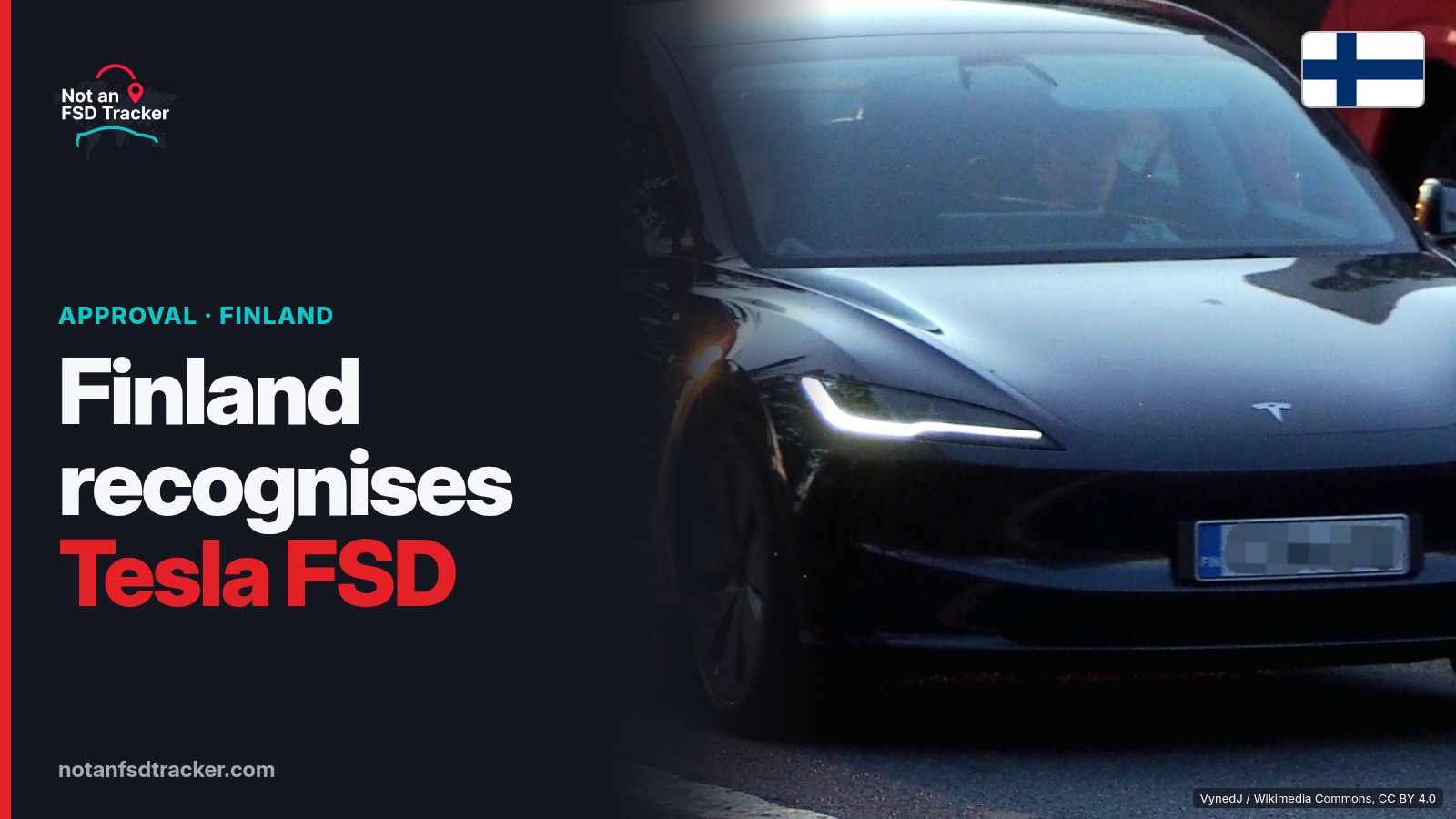
Twelve of the 27 member states allow the system. The Netherlands granted the RDW type approval, and the other eleven accepted it on their own roads. Italy is the most recent and the most populous. These are the dates on the EU tracker, with population from the Council of the EU's figures for 2026:
| # | Country | Allowed from | Population (Council, 2026) | Share of EU |
|---|---|---|---|---|
| 1 | Netherlands | 10 April 2026 | 18,191,086 | 4.0% |
| 2 | Lithuania | 20 May 2026 | 2,890,664 | 0.6% |
| 3 | Estonia | 29 May 2026 | 1,369,995 | 0.3% |
| 4 | Denmark | 9 June 2026 | 5,985,790 | 1.3% |
| 5 | Belgium | 10 June 2026 | 11,900,123 | 2.6% |
| 6 | Slovenia | 7 September 2026 | 2,130,850 | 0.5% |
| 7 | Czechia | 21 September 2026 | 10,921,096 | 2.4% |
| 8 | Croatia | 29 September 2026 | 3,874,350 | 0.9% |
| 9 | Slovakia | 16 October 2026 | 5,456,246 | 1.2% |
| 10 | Latvia | 26 October 2026 | 1,860,565 | 0.4% |
| 11 | Finland | 10 November 2026 | 5,626,971 | 1.2% |
| 12 | Italy | 20 November 2026 | 59,635,202 | 13.2% |
| Total, 12 countries | 129,842,938 | 28.7% |
Population from Annex III of the Council's Rules of Procedure, as set by Council Decision (EU, Euratom) 2025/2427 for 2026, which the Council's voting calculator uses. Shares are rounded to one decimal place, so they don't add up exactly to the total.
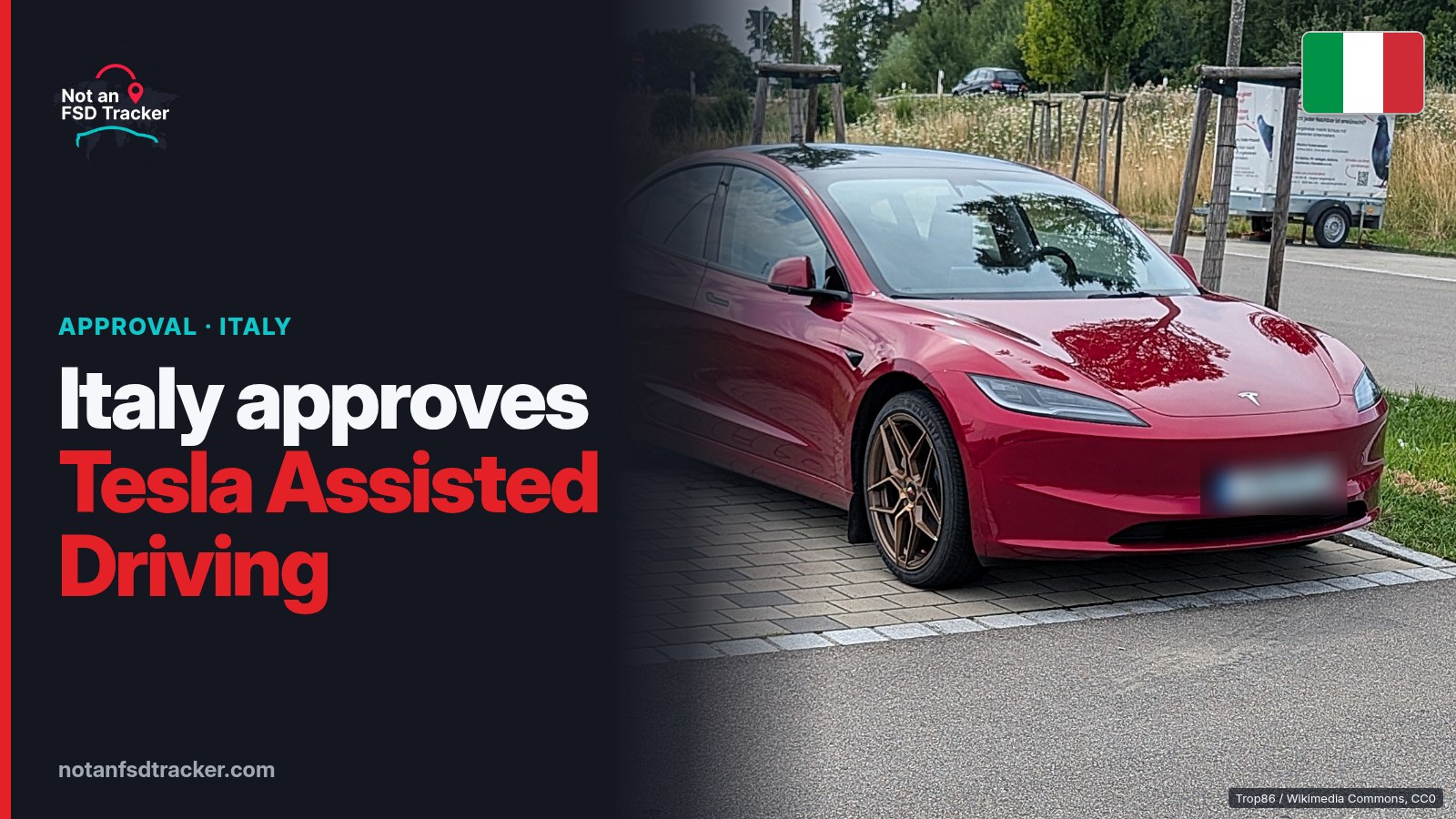
Italy's step is covered in Italy Approves Tesla FSD (Supervised) TAD as the 12th EU Country.
Can the twelve approved countries carry the TCMV vote?
Not on their own. The Council's figures put the EU's population at 452,162,974, so the 65% threshold is 293,905,933 people. If all twelve vote yes, they bring 12 states and 28.7%. That leaves at least three more states and another 36.3 percentage points, or 164,062,995 people, to find.
These are the fifteen countries that haven't approved it:
| Country | Population (Council, 2026) | Share of EU |
|---|---|---|
| Germany | 83,502,300 | 18.5% |
| France | 68,635,943 | 15.2% |
| Spain | 49,093,546 | 10.9% |
| Poland | 37,475,594 | 8.3% |
| Romania | 19,036,031 | 4.2% |
| Portugal | 10,749,635 | 2.4% |
| Sweden | 10,583,000 | 2.3% |
| Greece | 10,409,547 | 2.3% |
| Hungary | 9,539,502 | 2.1% |
| Austria | 9,180,000 | 2.0% |
| Bulgaria | 6,437,360 | 1.4% |
| Ireland | 5,440,278 | 1.2% |
| Cyprus | 982,966 | 0.2% |
| Luxembourg | 680,084 | 0.2% |
| Malta | 574,250 | 0.1% |
| Total, 15 countries | 322,320,036 | 71.3% |
Two examples show how the numbers work.
Example 1: Germany plus smaller states. Germany adds 18.5%, taking the yes side to 47.2% with 13 states. Poland (8.3%), Romania (4.2%), Portugal (2.4%) and Sweden (2.3%) take it to 64.4% with 17 states, still short. Adding Greece (2.3%) makes 66.7% with 18 states, which passes. Germany with France and Poland gets there with exactly 15 states and 70.7%.
Example 2: without Germany, France or Spain. The other twelve countries that haven't approved it hold 26.8% between them. If all of them voted yes, the yes side would have 24 states but only 55.5% of the population, so the population test would fail. The request would still pass, because Germany, France and Spain on their own are too few to form a blocking minority. It would need every other member state to vote yes.
Only four combinations of three more states reach 65%: Germany, France and Spain (73.2%); Germany, France and Poland (70.7%); Germany, France and Romania (66.6%); and Germany, Spain and Poland (66.3%). Germany is in all four. Without Germany, the shortest routes need four more states, for 16 in all: France, Spain, Poland and one of Romania (67.3%), Portugal, Sweden, Greece, Hungary or Austria.
The other side of the sum is the blocking minority. It needs at least four member states holding more than 35% of the population, and abstentions count against. If Germany and all twelve vote yes, the smallest possible blocking group is France, Spain and Poland, which hold 34.3% between them, plus one more country from Romania, Portugal, Sweden, Greece, Hungary, Austria, Bulgaria or Ireland.
It looks like Germany is the vote to watch. Its transport ministry said in October that Bilger would push for timely EU-wide approval, but a ministry statement isn't a recorded vote. Reuters reported on 25 September that several EU countries, including Sweden, had raised concerns about the system exceeding speed limits. That was before 3 November, when the RDW approved Tesla's changes, including a cap of +10% on the speed margin.
What happens if the TCMV votes no?
A no on 15 December wouldn't switch anything off straight away. The TCMV works under the examination procedure in Article 5 of Regulation (EU) No 182/2011. If the committee gives a positive opinion, the Commission "shall adopt" the draft. If it gives a negative opinion, the Commission "shall not adopt" it, but the chair can bring an amended draft back to the committee within two months, or send it to the appeal committee within one month.
If neither side reaches a qualified majority, there is no opinion. For type-approval acts, Article 83(2) of Regulation (EU) 2018/858 says the Commission then "shall not adopt the draft implementing act", and the same two options apply.
Going by the texts, the national approvals stay in force unless the Commission formally refuses the authorisation. Article 39(7) of Regulation (EU) 2018/858 says:
Where the Commission adopts implementing acts referred to in paragraph 3 to refuse to grant the authorisations, the approval authority shall immediately inform the holder of the provisional EU type-approval referred to in paragraph 4 that the provisional EU type-approval approval [sic] shall be revoked six months after the date of the implementing act.
The regulation doesn't say what happens to the other eleven countries' acceptances. It looks like a refusal would end the approval in all twelve, since they all rely on the same provisional approval, but that's an inference. The same paragraph says vehicles built under the provisional approval before it ceased to be valid can still be placed on the market, registered or enter into service in the countries that accepted it.
Is UN R171 Series 02 a Plan B for Tesla FSD (Supervised) TAD?
It is the other route. The current approval relies on Article 39 exemptions from UN Regulation No. 171 (DCAS). The 02 series of amendments to UN R171 was voted on at UNECE WP.29 in June 2026 and sets requirements for systems that perform system-initiated manoeuvres, including in non-highway environments.
The Department for Transport now understands that Series 02 enters into force on 27 December 2026, six months after the preliminary notification dated 27 June 2026, as covered in FOI: DfT Has Not Considered Objecting to UN Rules Covering Tesla FSD. The UN confirms the date in a depositary notification once the six months are up.
Once Series 02 is in force, an approval under it would be recognised by the parties that apply UN R171, the EU included, so it wouldn't need a TCMV vote on an exemption. It looks like that is the fallback if the Article 39 route stalls. Tesla hasn't said whether it has applied for a Series 02 approval. What the new rules would ask of Tesla's software is in What UN R171 Series 02 changes for Tesla FSD.
What is still unknown?
The draft implementing decision hasn't been published, so its conditions, such as any limits on vehicle numbers or the speed offset, aren't known. No member state has published how it will vote, and the agenda can still change before 15 December. The summary record of the 6 October meeting isn't public yet either. Approving it is item 2 on the same agenda.
The EU tracker and the FSD approval map will update on the day.
Sources
- Comitology Register: draft agenda of the 120th TCMV meeting, 15 December 2026 (A119538/01)
- Comitology Register: meeting CMTD(2026)1974
- Reuters via US News: EU may vote on authorising Tesla assisted-driving system at 15 December meeting, 26 November 2026
- Reuters via CNA: EU postpones discussion to approve Tesla's self-driving tech, 25 November 2026
- Reuters via CNA: EU vote on Tesla's supervised self-driving system pushed back, 25 September 2026
- Tesla Europe on X, 22 November 2025
- RDW: response following Tesla's call to action, 24 November 2025
- Tesla Europe on X, 20 March 2026
- Comitology Register: summary record of the 116th TCMV, 24 March 2026
- RDW: European type approval for Tesla with provisional validity in the Netherlands, 10 April 2026
- Comitology Register: summary record of the 117th TCMV, 5 May 2026
- Comitology Register: agenda of the 118th TCMV, 30 June 2026
- Comitology Register: summary record of the 118th TCMV, 30 June 2026
- Comitology Register: agenda of the 119th TCMV, 6 October 2026
- German Federal Ministry of Transport (BMV), 6 October 2026 (German)
- TechCrunch: Tesla renames 'Full Self-Driving' to 'Tesla Assisted Driving' in Europe, 9 October 2026
- RDW: RDW keurt wijzigingen aan Tesla-rijhulpsysteem goed, 3 November 2026 (Dutch)
- Council Decision (EU, Euratom) 2025/2427: population figures for 2026
- Council of the EU: voting calculator
- Council of the EU: qualified majority
- Regulation (EU) 2018/858, Article 39
- Regulation (EU) 2018/858, Article 83, as adopted, on legislation.gov.uk
- Regulation (EU) No 182/2011, Article 5
- UNECE: ECE/TRANS/WP.29/2026/86, proposal for the 02 series of amendments to UN Regulation No. 171
- Department for Transport, FOI-00081584, reply dated 9 November 2026
FAQ
When is the EU vote on Tesla FSD (Supervised) TAD?
Why was the TCMV meeting moved to 15 December?
How many votes does Tesla FSD (Supervised) TAD need at the TCMV?
Can the EU approve Tesla FSD (Supervised) TAD without Germany?
What happens to national approvals if the EU says no?
What is the Plan B if the TCMV vote fails?
Get the result the moment it lands. Instant approval alerts for the 15 December vote and every country decision, plus access to all my Tesla FSD tracking data on the new data platform, come with the £9 Insane tier at patreon.com/NotAnFSDTracker.