Luxembourg Points to the EU on Tesla FSD (Supervised) TAD Approval
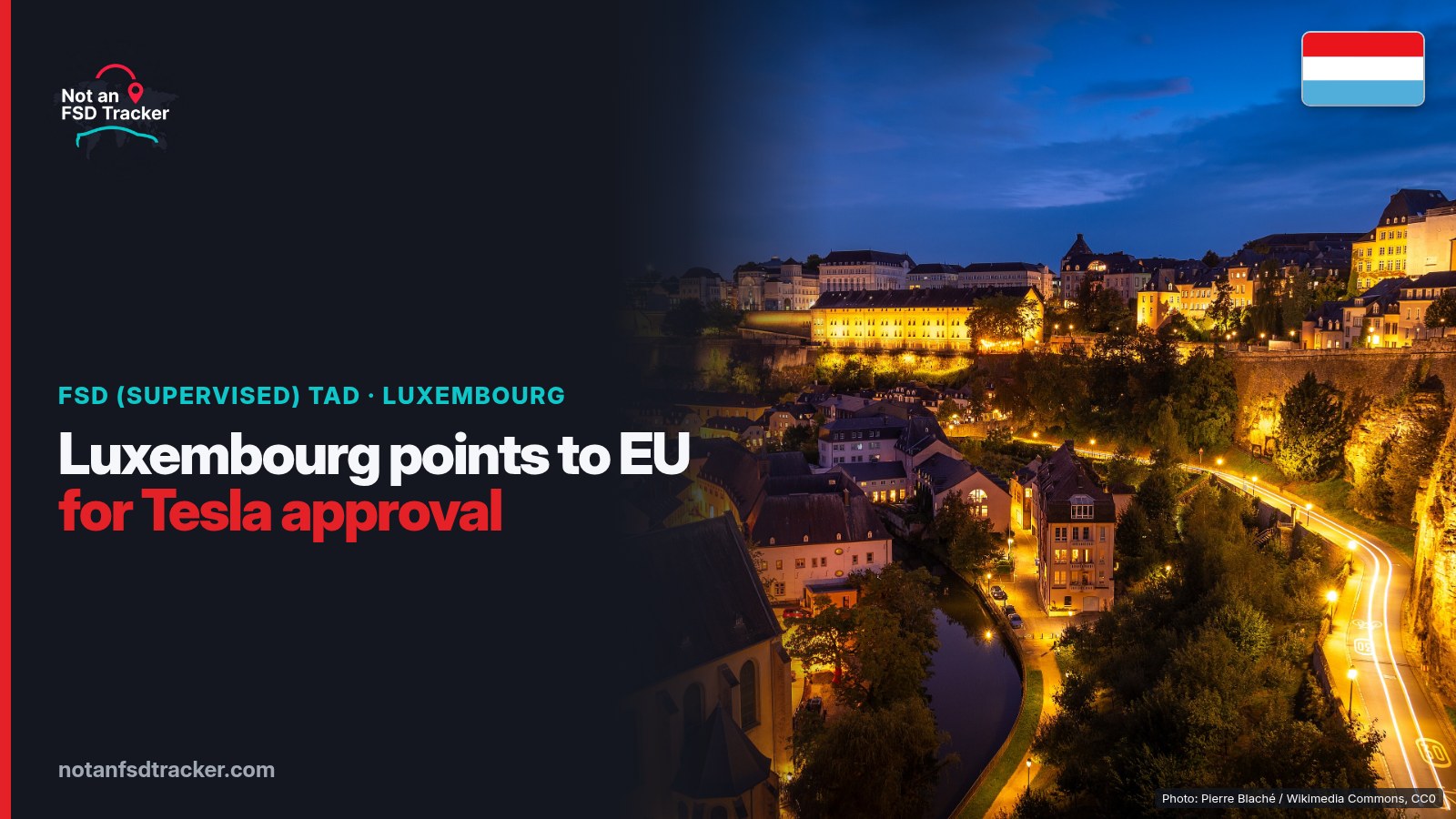
LUXEMBOURG, 20 October 2026. Luxembourg isn't saying no to Tesla FSD (Supervised) TAD, but it isn't following the Netherlands and Belgium either. In a written answer to Parliament dated 20 October 2026, Mobility Minister Yuriko Backes said the system is driver assistance rather than automated driving, that Luxembourg took no part in the Dutch national procedure, which is the process behind the RDW type approval, and that any change to the rules has to come through EU procedures backed by a rigorous safety assessment.
FSD (Supervised) TAD is Tesla's Full Self-Driving (Supervised), which Tesla now calls Tesla Assisted Driving (TAD) in Europe. The answer matters because Luxembourg is the third Benelux country. According to the Not an FSD Tracker EU tracker, the Netherlands approved FSD (Supervised) TAD in April 2026 and Belgium recognised that approval in June, so Luxembourg is now the only Benelux state where owners still can't use it, and the minister's answer points to EU procedures rather than to a national decision.
What MP Meris Sehovic asked about Tesla FSD (Supervised) TAD
MP Meris Sehovic filed parliamentary question n° 4802 (parliamentary document 51443) on 23 September 2026, and the Chamber declared it admissible on 24 September. His question linked two things: at the informal meeting of EU transport ministers in Dublin on 20 and 21 September 2026, the Benelux countries said they wanted to move faster on connected and automated driving, and, as he pointed out, the Dutch regulator RDW had granted a type approval for Tesla FSD (Supervised) TAD that is valid in the Netherlands.
He asked what "moving faster" means for the Luxembourg government in practice, and whether it includes mutual recognition or cross-border extension of authorisations granted in another Benelux state. He also asked whether that Benelux cooperation is linked to the Dutch procedure, whether Luxembourg was involved in any talks about it, and what position Luxembourg takes on a possible extension of the approval to the whole EU.
Luxembourg says Tesla FSD (Supervised) TAD is driver assistance, not automated driving
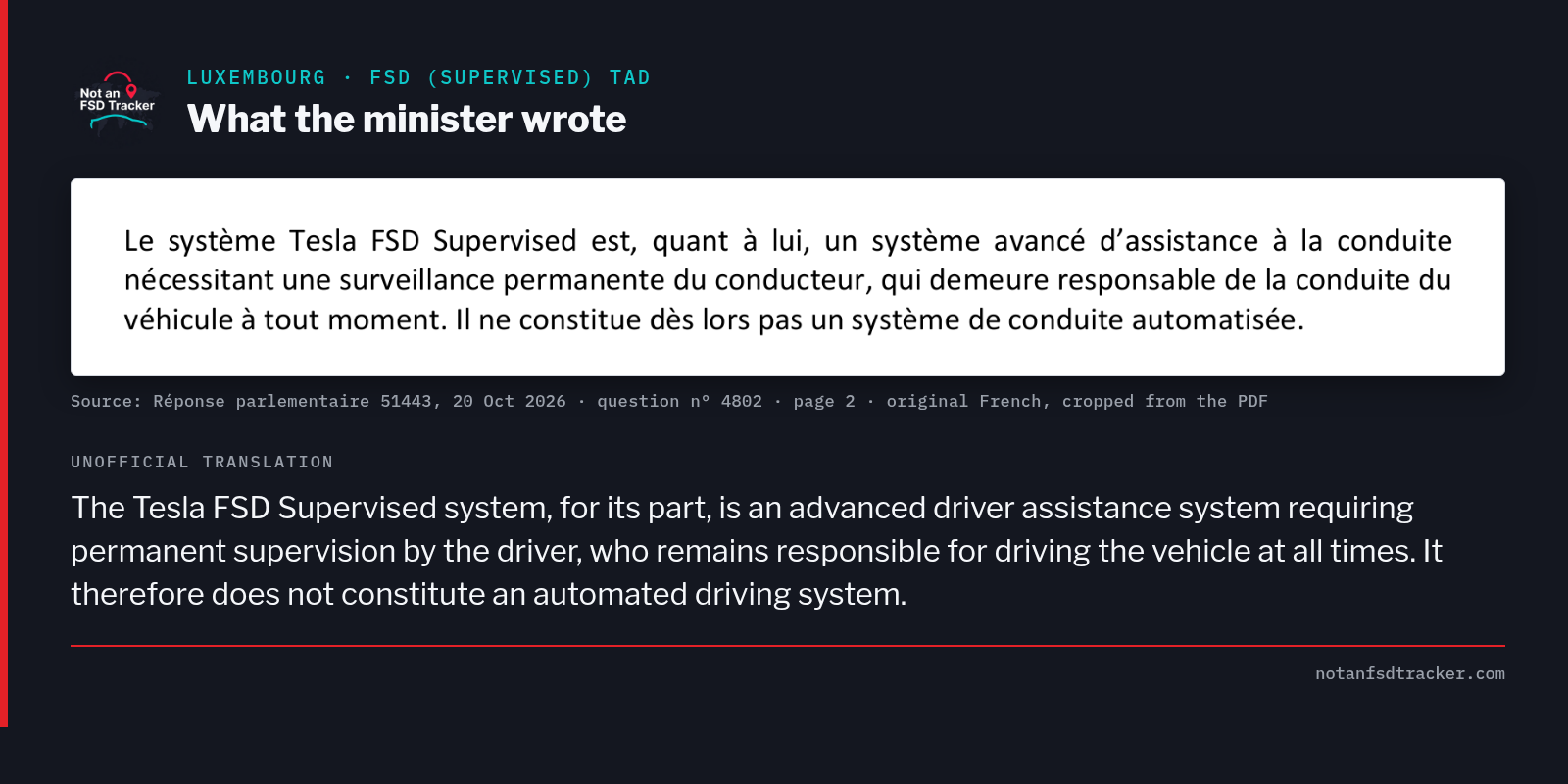
The clearest line in the answer is about what FSD (Supervised) TAD actually is. The minister wrote:
«Le système Tesla FSD Supervised est, quant à lui, un système avancé d’assistance à la conduite nécessitant une surveillance permanente du conducteur, qui demeure responsable de la conduite du véhicule à tout moment. Il ne constitue dès lors pas un système de conduite automatisée.»
In English: "The Tesla FSD Supervised system, for its part, is an advanced driver assistance system requiring permanent supervision by the driver, who remains responsible for driving the vehicle at all times. It therefore does not constitute an automated driving system."
It's an important distinction, because advanced driver assistance and automated driving sit in different legal boxes, and the minister is keeping FSD (Supervised) TAD firmly in the first one. It also explains why she treats Sehovic's two topics separately, because the Benelux work is about automated driving and, on her definition, FSD (Supervised) TAD isn't automated driving.
Luxembourg wasn't involved in the Dutch national procedure behind the RDW approval
On Sehovic's question about whether Luxembourg had a seat at the table, the answer is short and direct:
«Le Luxembourg n’a pas été associé à la procédure nationale néerlandaise relative à l’autorisation de ce système spécifique. Le Gouvernement suit néanmoins avec attention les évolutions technologiques et réglementaires relatives tant aux systèmes avancés d’assistance à la conduite qu’aux systèmes de conduite automatisée.»
In English: "Luxembourg was not involved in the Dutch national procedure for the authorisation of this specific system. The Government is nevertheless following technological and regulatory developments closely, both for advanced driver assistance systems and for automated driving systems."
The answer doesn't name the RDW, but the Dutch national procedure she refers to is the RDW type approval. So that approval was a Dutch process from start to finish, and Luxembourg is watching rather than taking part. That's not unusual, because the other countries that allow FSD (Supervised) TAD did it by recognising the Dutch approval after the RDW had issued it.
Why this isn't a no: Luxembourg backs a harmonised EU approach
When it comes to Luxembourg's position on extending the approval across the EU, the minister didn't say how Luxembourg would vote, and she didn't rule anything out. Instead, she set out the principle the government is working from:
«De manière générale, le Gouvernement soutient une approche harmonisée au niveau européen fondée sur des exigences élevées en matière de sécurité routière, de conformité réglementaire et de clarté quant aux responsabilités des différents acteurs. Toute évolution du cadre applicable doit reposer sur les procédures prévues au niveau européen ainsi que sur une évaluation rigoureuse de la sécurité des systèmes concernés.»
In English: "In general, the Government supports a harmonised approach at European level, based on high requirements for road safety, regulatory compliance and clarity about the responsibilities of the different actors. Any change to the applicable framework must be based on the procedures provided for at European level, as well as on a rigorous assessment of the safety of the systems concerned."
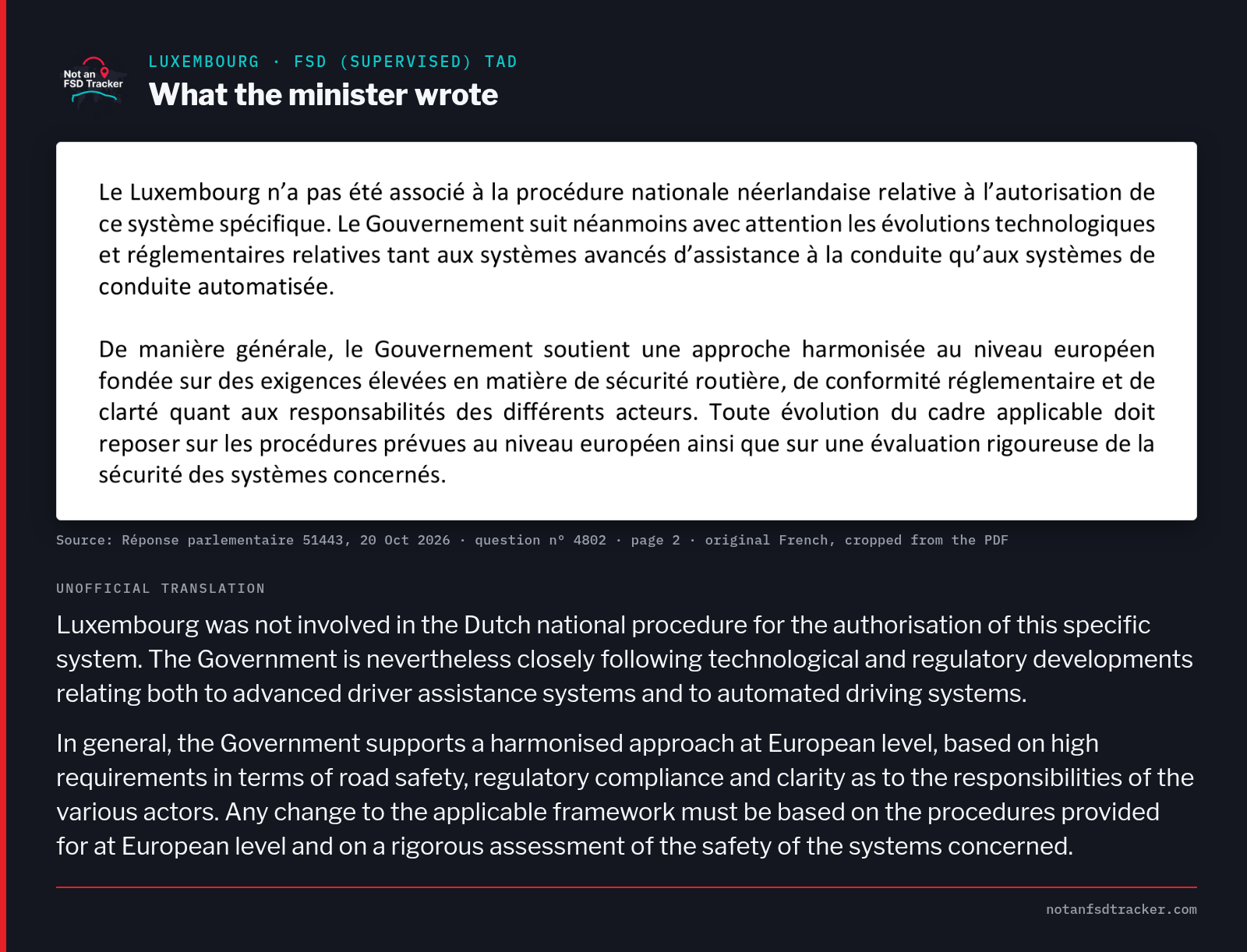
She doesn't say Luxembourg is waiting, but I think that leaves Luxembourg waiting for an EU decision rather than rejecting FSD (Supervised) TAD. There's no criticism of the Dutch approval in the answer and no list of objections, and it looks like Luxembourg would rather see this settled once, at EU level, than country by country.
The EU route runs through the Technical Committee on Motor Vehicles, the TCMV, where member states vote on the Dutch request to approve FSD (Supervised) TAD across the bloc. Reuters reported on 25 September 2026 that the expected October vote had slipped, and that December is the earliest apparent chance of a decision. An EU-wide approval needs a qualified majority of 15 of the 27 member states, representing 65% of the EU population, so Luxembourg's vote counts towards the 15 countries, although its small population carries little weight in the 65% test.
The Benelux "move faster" plan on automated driving is a separate track
Sehovic asked about the Benelux cooperation discussed in Dublin, and the minister was clear that it has nothing to do with the Dutch procedure for FSD (Supervised) TAD:
«La coopération Benelux évoquée lors de la réunion informelle des ministres des Transports et la procédure menée aux Pays-Bas concernant le système Tesla FSD Supervised constituent deux démarches distinctes.»
In English: "The Benelux cooperation mentioned at the informal meeting of transport ministers and the procedure carried out in the Netherlands concerning the Tesla FSD Supervised system are two separate processes."
According to the answer, "moving faster" means Belgium, the Netherlands and Luxembourg working more closely to speed up a legal and operational framework for connected and automated mobility across their borders. A Benelux working group on automated driving was set up in 2026, and its main job is drafting a Benelux legal instrument for cross-border pilot projects with vehicles fitted with automated driving systems.
Mutual recognition is one of the central themes, but it's about test vehicles, not cars on sale. The partners are looking at:
«la mise en place d’un mécanisme permettant la reconnaissance mutuelle des réceptions nationales individuelles accordées à des prototypes de véhicules destinés à être testés dans plusieurs pays du Benelux»
In English: "setting up a mechanism allowing the mutual recognition of individual national approvals granted to prototype vehicles intended to be tested in several Benelux countries."
That mechanism is still being examined rather than agreed. The three countries are also working on a common framework for assessing pilot projects, covering safety, risk management, supervision of operations, incident management and the responsibilities of everyone involved. The minister tied all of this to Luxembourg's national strategy «Automatiséiert Fueren 2028», and to the «European Testbed for Connected and Automated Driving» initiative, whose political declaration was signed in Luxembourg in June 2026.
Therefore, based on the minister's description, the Benelux work isn't a route for the RDW type approval into Luxembourg, because it's built for automated prototypes in cross-border trials and she has already said FSD (Supervised) TAD isn't an automated driving system.
Tesla FSD (Supervised) TAD in the Benelux: where each country stands
| Country | Status | How it happened |
|---|---|---|
| Netherlands | Approved | RDW type approval, April 2026 |
| Belgium | Approved | Recognised the RDW type approval, June 2026 |
| Luxembourg | Not approved for owners | Tesla holds a ministerial testing authorisation (June 2026), but there's no approval for owners, and the minister points to EU procedures (20 October 2026) |
Status and dates: Not an FSD Tracker EU tracker. The minister's answer doesn't give a status.
Across the EU, the Not an FSD Tracker EU tracker shows nine countries that have approved or recognised FSD (Supervised) TAD: the Netherlands, Lithuania, Estonia, Denmark, Belgium, Slovenia, Czechia, Croatia and Slovakia. You can see every country's status on the FSD (Supervised) TAD Europe map and the EU tracker, and the Netherlands and Belgium pages cover how the first two Benelux decisions happened.
What happens next for Tesla FSD (Supervised) TAD in Luxembourg: the EU TCMV vote
For Luxembourg owners, the realistic path now runs through the TCMV. If the committee votes in December and the Dutch request gets a qualified majority, that would open the way to an EU-wide approval covering Luxembourg too, without a separate national decision. If the vote slips again, it's possible Luxembourg could still recognise the RDW type approval on its own, as eight other countries have, but nothing in this answer suggests that's on the table.
The Benelux pilot work will carry on alongside that, and it may well shape how automated driving is tested across the three countries, but it's a different question from whether you can use FSD (Supervised) TAD on Luxembourg roads. If you want the regulatory background on what FSD (Supervised) TAD has to meet in Europe, the UNECE R171 Series 02 explainer covers it.
Related reading: Norway's answer to its parliament on Tesla FSD (TAD) and Spain's position ahead of the EU vote.
Sources
- Chambre des Députés: parliamentary question n° 4802 (parliamentary document 51443) by Meris Sehovic, filed 23 September 2026
- Written answer to question n° 4802 from Mobility Minister Yuriko Backes, 20 October 2026 (PDF, French)
- Reuters: EU vote on Tesla's supervised self-driving system pushed back, 25 September 2026
- Not an FSD Tracker EU tracker, for the country statuses and the list of nine countries
- Quotes are from the original French, with unofficial English translations by Not an FSD Tracker.