Norway Rules Out National Approval for Tesla FSD (TAD) and Will Wait for the EU
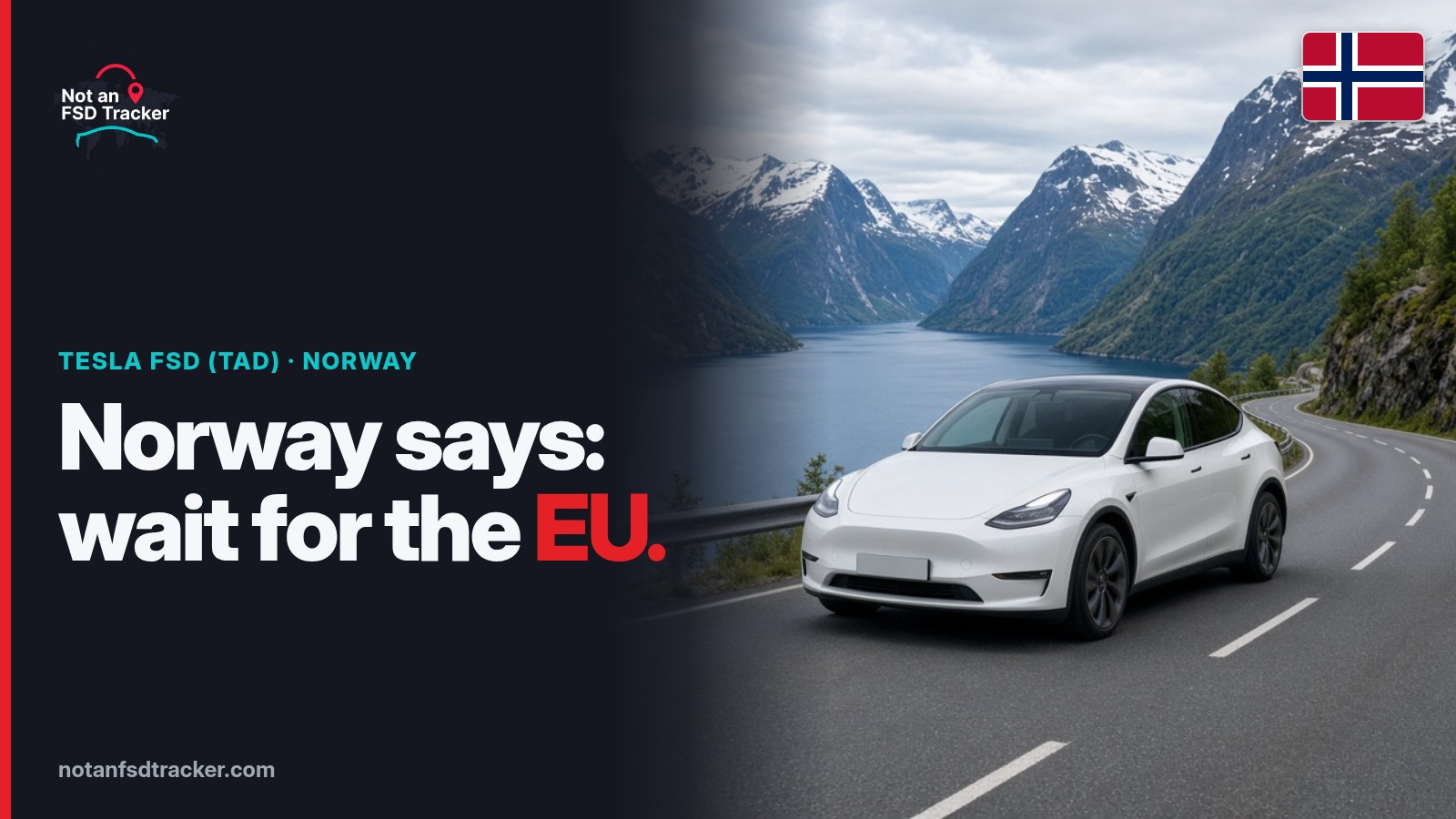
OSLO, 17 October 2026. Norway will not recognise Tesla FSD (TAD) on its own. Transport Minister Kamzy Gunaratnam said so in a written answer to the Storting, the Norwegian parliament, on Friday 16 October 2026. Norway will wait for the EU's decision, and if the EU approves the system, Norway will follow under the EEA Agreement.
Tesla now calls FSD (Supervised) Tesla Assisted Driving (TAD) in Europe, and "Tesla Assistert Kjøring" on its Norwegian pages. The minister's answer uses both names.
It is also the clearest statement yet of why Norway is holding back. The headline line, translated from Norwegian:
"Since that meeting, it has been demonstrated that the system can actually break speed limits."
All quotes in this article are my translations from the Norwegian original on stortinget.no.
The question: will Norway recognise Tesla FSD like Denmark did?
The question came from Jørgen H. Kristiansen of the Christian Democrats (KrF). He asked two things:
- Will the Government give Norwegian input before the EU considers Tesla FSD (Supervised)?
- If the EU approves it, will the Government consider national recognition, "as Denmark among others has done"?
In his reasoning, Kristiansen said Statens vegvesen, the Norwegian Public Roads Administration, had told him Norway did not give input to the EU technical committee before its 6 October 2026 meeting, where the item was pushed back to December. He pointed to Norway's serious accident figures and asked whether the Government would back new technology that could improve road safety.
| The parliamentary record | |
|---|---|
| Document | Dokument nr. 15:116 (2026-2027), written question |
| Asked by | Jørgen H. Kristiansen (KrF) |
| Addressed to | Minister of Transport |
| Submitted | 8 October 2026 |
| Sent to the minister | 9 October 2026 |
| Answered | Friday 16 October 2026, by Transport Minister Kamzy Gunaratnam |
| Outcome | No national recognition. Norway waits for the EU and follows under the EEA Agreement |
What Norway's transport minister said about Tesla Assisted Driving
Gunaratnam opened positively. She said she is "positive about new vehicle technology, as it can solve many of the mobility needs of the future and improve road safety", but that the technology used on Norwegian roads has to protect road safety.
Then she set out the problem as Norway sees it.
The driver is fully responsible. With advanced driver assistance, she said, the driver is "still fully and wholly responsible for the driving under the Road Traffic Act."
Hands-off feels like self-driving. Some systems let the driver go long periods without hands on the wheel. Her words:
"The system can therefore give the impression of being self-driving even though the driver is still fully and wholly responsible for the driving. This means increased risk, particularly in situations where the system expects the driver to take control immediately. Such systems do not satisfy the requirements of the current international regulations."
She named Tesla's system as an example, noting it "recently changed its name from Full Self Driving (Supervised) to Tesla Assisted Driving".
The Dutch exemptions. She said the Netherlands approved the system with exemptions from some international requirements, and that the Dutch authorities have applied for EU type approval through an exemption process in EU rules. That's the Article 39 route we've covered in Tesla's Article 39 dashboard.
The exemptions, in her words, relate to "the requirement that limits the ability to drive without hands on the wheel outside motorways and the requirements to comply with speed limits." Then the important part: "The latter are requirements that Norway in particular worked to get into the regulations."
So speed limits aren't a side issue for Norway. Norway helped write those rules.
Norway's input to the EU committee and the speed limit claim
The minister said Statens vegvesen gave input on Norway's behalf to the vehicle committee meeting on 30 June. The aim was to hear other countries' views on three things:
- the exemptions from the speed limit requirements
- inadequate and misleading driver information
- an "abnormal gap" between what the marketing says and what the user manual says
Then came the line that will get the most attention:
"Since that meeting, it has been demonstrated that the system can actually break speed limits. It is not yet known how the other member states will respond to this in the rest of the EU process."
The answer doesn't say who demonstrated it or how. Speed is already the live issue in the EU file, though. Germany says it will back a maximum 10% speed offset (see Germany's Transport Minister Backs FSD Approval), and Sweden has objected on speed offset grounds before (see Sweden's TCMV objection).
There is a small gap worth noting. Kristiansen was told Norway gave no input before the 6 October meeting. The minister says Norway did give input before the 30 June meeting. Both can be true.
What Norway says Tesla has already changed
It isn't all negative. The minister listed three things Tesla has done since:
- released some of the documentation from the approval
- "somewhat toned down" its marketing of the safety potential
- changed the "previously misleading name" Full-Self-Driving (Supervised)
We covered that rename in Why Tesla Is Renaming FSD in Europe to Tesla Assisted Driving, and there's a plain-English explainer at What is Tesla Assisted Driving?
On how the system drives, she passed on Statens vegvesen's view:
"The Norwegian Public Roads Administration says the driver assistance system appears to handle normal traffic situations well. It is nevertheless uncertain how well the new technology can ensure that the driver is attentive and ready to take over control immediately when the system fails or cannot handle unforeseen situations."
That's a fair summary of where most regulators are. The driving isn't really the argument any more. Driver attention is.
The decision: Norway waits for the EU
Her conclusion, translated:
"In this case, I believe road safety is best safeguarded by Norway awaiting the EU's decision. If the EU approves the system, we in Norway will act on this in accordance with our obligations under the EEA Agreement."
She added that drivers who use it must get clear guidance on how it works and its limits, and must understand the driver is always responsible. She also said Statens vegvesen will keep working on road safety in the international rules for driver assistance and automated driving.
Honest answer on what this means: no national shortcut for Norway. Norway is in the EEA but not the EU, so it doesn't vote in the EU committee. If the EU says yes, though, Norway is committed to follow.
How Norway compares with its neighbours and the rest of Europe
Nine EU countries have recognised the Dutch approval so far: the Netherlands, Lithuania, Estonia, Denmark, Belgium, Slovenia, Czechia, Croatia and Slovakia. Slovakia was the latest on 16 October, the same day as Norway's answer (see Slovakia Gives Preliminary Approval to Tesla FSD (TAD)).
Norway now joins the countries that have said, on the record, they won't go it alone.
| Country | Position on Tesla FSD (TAD) | Source and date |
|---|---|---|
| Norway | No national recognition. Waits for the EU, then follows under the EEA Agreement | Transport minister, Storting answer, 16 Oct 2026 |
| Denmark | Approved. Rollout underway on HW4 | Tesla Europe, 9 Jun 2026 |
| Sweden | Public road testing. Recommends opposing EU-wide approval unless the speed offset is disabled | Transportstyrelsen, May 2026 |
| Finland | Traficom still reviewing the Dutch approval. No national decision | Traficom, Jun 2026 |
| Austria | No national recognition. Waits for the EU committee | BMIMI, 7 Jul 2026 |
| Spain | No unilateral decision. Coordinating with the EU | Industry ministry, Jul 2026 |
So in the Nordics, Denmark is the only yes. Every country's status is on the EU tracker and the Tesla FSD Europe map.
What happens next
The EU committee (TCMV) discussed Tesla FSD on 6 October 2026 without a vote. December 2026 is the earliest chance of one. An EU-wide yes needs a qualified majority of 15 of the 27 member states, representing 65% of the EU population, and then a Commission implementing act. We've mapped that clock in How Soon Could EU Tesla FSD Be Available After a TCMV Yes Vote?
For Norwegian owners, that's the date to watch. Norway won't move first, but the minister has now said in writing that it will follow an EU approval. If you want the rules underneath all this, our UNECE R171 Series 02 explainer covers them.
I'll be watching the December agenda. Sign up below to get the alert when it lands.
Sources
- Stortinget: written question from Jørgen H. Kristiansen (KrF) to the Minister of Transport, Dokument nr. 15:116 (2026-2027), answered 16 October 2026
- Quotes are translated from Norwegian.
- Other country positions: Not an FSD Tracker EU tracker