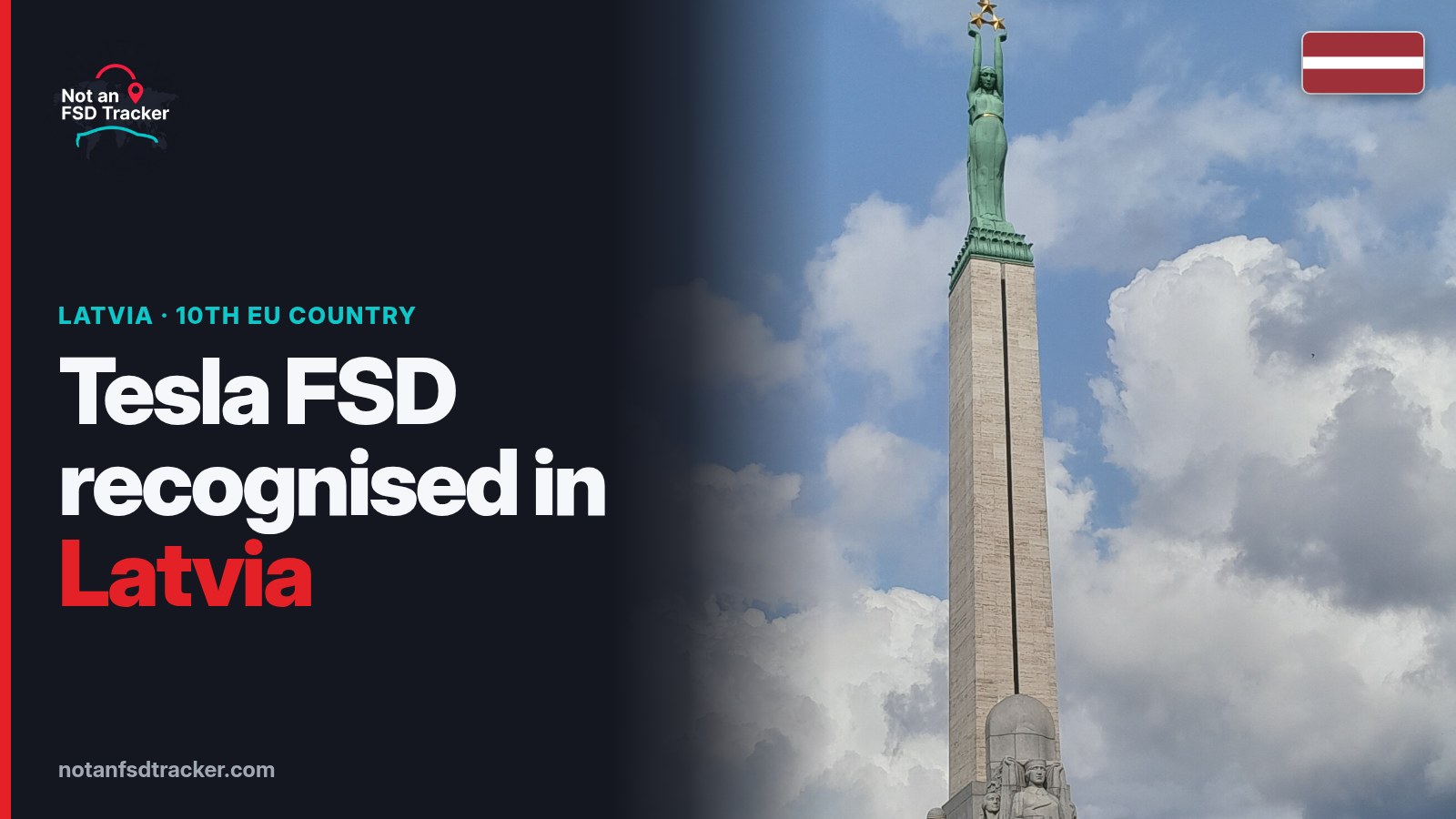
Latvia Recognises Tesla FSD (Supervised) TAD as the 10th EU Country
26 October 2026. Latvia has recognised the Dutch RDW type approval of FSD (Supervised) TAD, making it the tenth of the EU's 27 member states to do so and the last of the three Baltic states. The Road Traffic Safety Directorate (CSDD), Latvia's vehicle approval authority, made the call after a six-month review that included Latvian road tests, requests for winter data and a public dispute between two ministries.
It hasn't reached customer cars yet, and Tesla says the rollout begins soon.
What did Tesla Europe and CSDD say about Latvia today?
Tesla's Europe, Middle East and Africa account announced it on X at 10:36 GMT:
Now approved in Latvia 🇱🇻
Tesla Europe, Middle East & Africa (@teslaeurope) 26 October 2026
Rollout begins soon
CSDD's own statement, carried by Apollo.lv, iAuto and BB.LV, was more careful. It says CSDD "has recognised the provisional European Union type approval issued by the Netherlands approval authority (RDW)" for the system, which it describes as "called 'Tesla Assisted Driving' in Europe (previously 'Full Self-Driving (Supervised)')". Quotes from CSDD and Latvian officials in this article are translated from Latvian.
The key line explains how CSDD got there:
"The decision was taken after assessing the RDW approval documentation, cooperating with RDW and the approval authorities of other member states, and assessing information provided by the manufacturer, including on the changes made, which provide for a reduction in the maximum threshold for exceeding the speed limit, an automatic reset of a manually set speed offset after every trip, and a strengthening of the driver monitoring system."
CSDD calls it a Level 2 system that can brake, steer, change lanes and cross junctions along a navigation route. The driver must be ready to take over immediately, may not use a smartphone and stays fully responsible for any offence or crash.
The directorate added a warning specific to Latvia: "Snow, mud and salt can disrupt the system's operation in Latvia, and on gravel roads it may work inadequately, and in such conditions the system may unexpectedly hand control back to the driver." It also told drivers that "the better the system works, the easier it is to lose vigilance, but precisely at the moment the system makes a mistake, the driver must be ready to act immediately."
In a statement reported by TVNET, Tesla said the rollout would come shortly by software update.
Terminology
- FSD. FSD stands for Full Self-Driving, and here it refers to the supervised version, where the driver must watch the road and stays responsible, with 'FSD' used for short.
- TAD. Tesla Assisted Driving is the name Tesla now uses in Europe for FSD (Supervised), which is why this article writes FSD (Supervised) TAD.
- RDW type approval. The RDW is the Dutch vehicle authority, and its provisional type approval of 10 April 2026 is the only approval of FSD (Supervised) TAD in the EU that other countries are recognising.
- Article 39. Article 39 of EU Regulation 2018/858 lets an approval authority exempt a new technology from rules it can't yet meet, first nationally and then EU-wide if the Commission authorises it.
- TCMV. The Technical Committee on Motor Vehicles is the committee of member state experts that votes on whether the Commission should authorise an Article 39 exemption across the EU.
- CSDD. Ceļu satiksmes drošības direkcija, the Road Traffic Safety Directorate, is the state-owned company that acts as Latvia's vehicle approval authority.
How did FSD (Supervised) TAD get from the RDW to Latvia?
None of the ten countries approved FSD (Supervised) TAD from scratch. Each accepted one Dutch decision.
Step 1: the RDW provisional type approval in April
On 10 April 2026, the RDW issued a European type approval with provisional validity in the Netherlands for FSD (Supervised), after more than a year and a half of testing on its track and on public roads. It stressed that "a vehicle with FSD Supervised is not self-driving" and that the driver "remains responsible and must always remain in control".
It was "currently valid only in the Netherlands", and there's more in the RDW approval of Tesla FSD Supervised.
Step 2: why the RDW needed Article 39
Article 39 of Regulation (EU) 2018/858 covers "new technologies or new concepts that are incompatible with one or more regulatory acts". The manufacturer must show the measures taken "to ensure at least an equivalent level of safety", backed by test results. The Commission decides by implementing act, and "pending adoption" of that act the national authority can grant a provisional approval "valid only in the territory of the Member State of that approval authority".
FSD (Supervised) TAD needed that route because R171 Series 01, the regulation in force, only lets a system start a manoeuvre by itself on a highway and without withholding hands-on requests. City lane changes and junctions sit outside it, as the UNECE R171 Series 02 explainer sets out.
In an opinion of 31 August, Latvia's Ministry of Transport (Satiksmes ministrija) listed the four deviations from the regulation that, according to the RDW, the provisional approval allows:
- the system determines the permitted speed from context, which allows it to exceed the speed limit;
- the system carries out a manoeuvre without an active hands-on request;
- the system doesn't stop a manoeuvre when it detects that the driver is inattentive;
- the set lateral acceleration limits for driving through bends aren't respected.
That matches the Article 39 objections dashboard. The opinion adds that Tesla's conventional Level 2 system has had an EU-wide UN approval since 25 February 2026, while FSD (Supervised) TAD holds only the provisional approval, numbered e4*2019/2144*171R01/00*00001*00, "because it has not met several safety conditions of UN Regulation No. 171".
Step 3: the TCMV vote that would make it EU-wide
Article 39(3) makes an EU-wide exemption "subject to the authorisation by the Commission". That means a vote at the Technical Committee on Motor Vehicles (TCMV), where the Dutch request needs a qualified majority of at least 15 of the 27 member states, representing at least 65% of the EU's population. There's more on what happens after a TCMV yes vote.
The committee was due to continue discussions on 6 October, so December is the earliest apparent opportunity for a vote, although none has been announced. France's transport minister, Philippe Tabarot, said on 2 September that French authorities were working with Tesla on the technical adaptations that would let France support approval, and that road tests with two cars were starting. Sweden's transport administration, Trafikverket, wrote to the committee on 30 April recommending a vote against unless the speed offset is removed, a letter Reuters first reported in June. Germany's transport ministry said on 6 October that it had agreed with Tesla that the system may exceed the speed limit by at most 10%, and that it backs timely EU-wide approval.
Step 4: national recognition, one country at a time
Until then, Article 39(5) says other member states' approval authorities "may accept the provisional EU type-approval" on their own territory, if they tell the granting authority in writing. Latvia used it today, and each recognition covers only the country that makes it.
| Country | Date | Status |
|---|---|---|
| Netherlands | 10 April 2026 | RDW provisional type approval, rollout active |
| Lithuania | 20 May 2026 | Recognised, rollout active |
| Estonia | 29 May 2026 | Recognised, rollout active |
| Denmark | 9 June 2026 | Recognised, rollout active |
| Belgium | 10 June 2026 | Recognised, rollout active |
| Slovenia | 7 September 2026 | Recognised, rollout pending |
| Czech Republic | 21 September 2026 | Recognised, rollout pending |
| Croatia | 29 September 2026 | Recognised, rollout pending |
| Slovakia | 16 October 2026 | Recognised, rollout pending |
| Latvia | 26 October 2026 | Recognised, rollout pending |
Dates and statuses are from the EU tracker, last updated on 26 October 2026. The other 17 EU countries haven't recognised the RDW type approval, as the FSD approval map shows.
What has Latvia been doing since April?
Most of this timeline comes from the Economics Ministry's report to the Cabinet of Ministers, published for consultation as project 26-TA-2030 and reported on 21 September.
- 13 April. Tesla's EU policy lead, Ivans Komusanacs, asked the Ministry of Transport and CSDD to start recognising the RDW type approval.
- 20 April and 12 May. The ministry asked for missing documents, then for more information, including on winter driving.
- May. CSDD said on Facebook that Latvian tests found the system missing traffic lights, choosing the wrong lane and not adapting to speed limit changes, as Uzlādēts reported on 24 May.
- 1 July. Economics Minister Viktors Valainis met Tesla and saw a demonstration.
- 31 July. Tesla said it had sent CSDD everything requested but had no decision.
- 26 August to 18 September. The Economics Ministry's report, out for consultation, proposed giving CSDD 10 working days to recognise the approval unless there were grounds to refuse, and backing the Dutch request at the TCMV if it matched the RDW's conditions. The Transport and Justice ministries both declined to approve the report.
- 26 October. CSDD recognised the RDW type approval.
The dispute was about who decides. On 18 September, the Ministry of Transport argued that recognition under Article 39(5) "is in essence within the competence of CSDD as the competent approval authority, and therefore the taking of such a decision is not a matter for the administrative competence of the Ministry of Transport or the Cabinet of Ministers". The Ministry of Justice made a similar point on 15 September. The public record doesn't show whether the Cabinet adopted the report.
It looks like Tesla's changes moved CSDD more than the politics did, because the lower speed offset, the reset after every trip and stronger driver monitoring match the concerns the Ministry of Transport raised in August.
What have Latvian officials said about Tesla FSD (Supervised) TAD?
After meeting Tesla on 1 July, Valainis said in a ministry press release:
"The development of automated driving technologies is part of future mobility. For such technologies to be introduced safely in practice, a modern legal framework is needed that both encourages innovation and ensures the highest road safety standards. Dialogue with companies in the sector and technology developers is an important precondition for Latvia to keep pace with the rapid development of mobility in Europe and the world. In the near future, political discussions will be launched in cooperation with the responsible institutions to ensure the fastest possible progress in resolving this issue."
Six days earlier, as Latvian Radio reported Latvia was the only Baltic state yet to recognise it, Jānis Kalniņš of the Ministry of Transport's road traffic department explained why:
"Latvia has currently chosen to give a joint assessment of this system together with other countries. Not to rush straight away to recognise the opinion given by the Netherlands, but to additionally evaluate, ask the car manufacturer additional questions and then take a decision together with experts. The approach to tests in Europe and America also differs. Perhaps in the US this approach is freer."
CSDD said in May, as reported by Uzlādēts, that it supported new safety technology but that "before such systems are introduced in real road traffic, they must be thoroughly tested and safe in all situations". The Ministry of Transport's opinion of 31 August was blunter, calling it "in fact a Level 2 driver assistance system with increased autonomy, which is achieved at the expense of reduced safety requirements". In the same opinion the ministry declined to approve the Economics Ministry's report, objecting to parts of its text and to the instruction to CSDD, but proposed that the Cabinet decide Latvia supports the Dutch request at the TCMV.
The Economics Ministry's report, as summarised by Nozare.lv, pointed out that the RDW had assessed the system for more than 18 months and still monitors it.
What does Latvia mean for the EU vote on Tesla FSD (Supervised) TAD?
Latvia adds a tenth country but little population weight. On Eurostat's figures for 1 January 2026, the ten countries hold about 64.5 million people, roughly 14.3% of the EU's 452 million, and Latvia about 0.4%. Germany, France, Italy and Spain hold about 58%, so the 65% threshold needs some of them. A recognition isn't a vote either, and no published government decision confirms Latvia's TCMV position. It looks like Latvia is more likely to back the Dutch request now that its own authority has accepted the RDW's assessment, but that's an inference.
When will FSD (Supervised) TAD reach Latvian Tesla owners?
Tesla hasn't given a date beyond "soon". The first four countries to recognise the RDW type approval now have active rollouts, while Slovenia, the Czech Republic, Croatia and Slovakia are still waiting. It looks like Latvian owners will join that queue, and the first winter will test CSDD's warnings about snow, salt and gravel.
The EU tracker will show when the rollout starts. There's more in what Tesla Assisted Driving is, and on the Slovakia recognition that came ten days earlier.
Sources
- Tesla Europe, Middle East & Africa on X, 26 October 2026
- Apollo.lv (LETA): CSDD recognises the provisional approval issued in the Netherlands, 26 October 2026 (Latvian)
- iAuto: Latvia recognises the provisional type approval issued in the Netherlands, 26 October 2026 (Latvian)
- BB.LV: Latvia recognises the Tesla driver assistance system, 26 October 2026 (Latvian)
- TVNET: Tesla Assisted Driving to be introduced in Latvia, 26 October 2026 (Latvian)
- Latvian Cabinet legislative portal: project 26-TA-2030, Economics Ministry information report on recognising the RDW approval (Latvian)
- Ministry of Transport opinion on 26-TA-2030, 31 August 2026 (Latvian)
- Ministry of Transport opinion on 26-TA-2030, 18 September 2026 (Latvian)
- Ministry of Justice opinion on 26-TA-2030, 15 September 2026 (Latvian)
- iAuto (Nozare.lv): Economics Ministry proposes recognising the Dutch approval, 21 September 2026 (Latvian)
- Ministry of Economics: Valainis meets Tesla representatives, 1 July 2026 (Latvian)
- LSM.lv (Latvian Radio): Latvia the only Baltic state not rushing to introduce the Tesla system, 25 June 2026 (Latvian)
- Uzlādēts: CSDD slows Tesla FSD introduction in Latvia, 24 May 2026 (Latvian)
- RDW: explanation of the European type approval for Tesla with provisional validity in the Netherlands, 10 April 2026
- Regulation (EU) 2018/858, Article 39
- Reuters: EU vote on Tesla's supervised self-driving system pushed back; the committee was due to continue discussions on 6 October, 25 September 2026
- franceinfo: France authorises road tests of Tesla FSD, quoting Philippe Tabarot, 2 September 2026 (French)
- Reuters: Sweden may oppose Tesla's supervised self-driving tech over speeding, on Trafikverket's 30 April letter, June 2026 and SVT, 30 June 2026 (Swedish)
- German Federal Ministry for Transport (BMV): current status of the Tesla assistance system approval, 6 October 2026 (German)
- Council of the EU: qualified majority
- Eurostat: population on 1 January 2026 (tps00001)
- EU tracker, for country statuses, recognition dates and each member state's national position
- UNECE R171 Series 02 explainer and Article 39 dashboard, for Series 01 and Tesla's exemption requests