Tesla FSD (Supervised): What Is TAD vs TAD Basic?
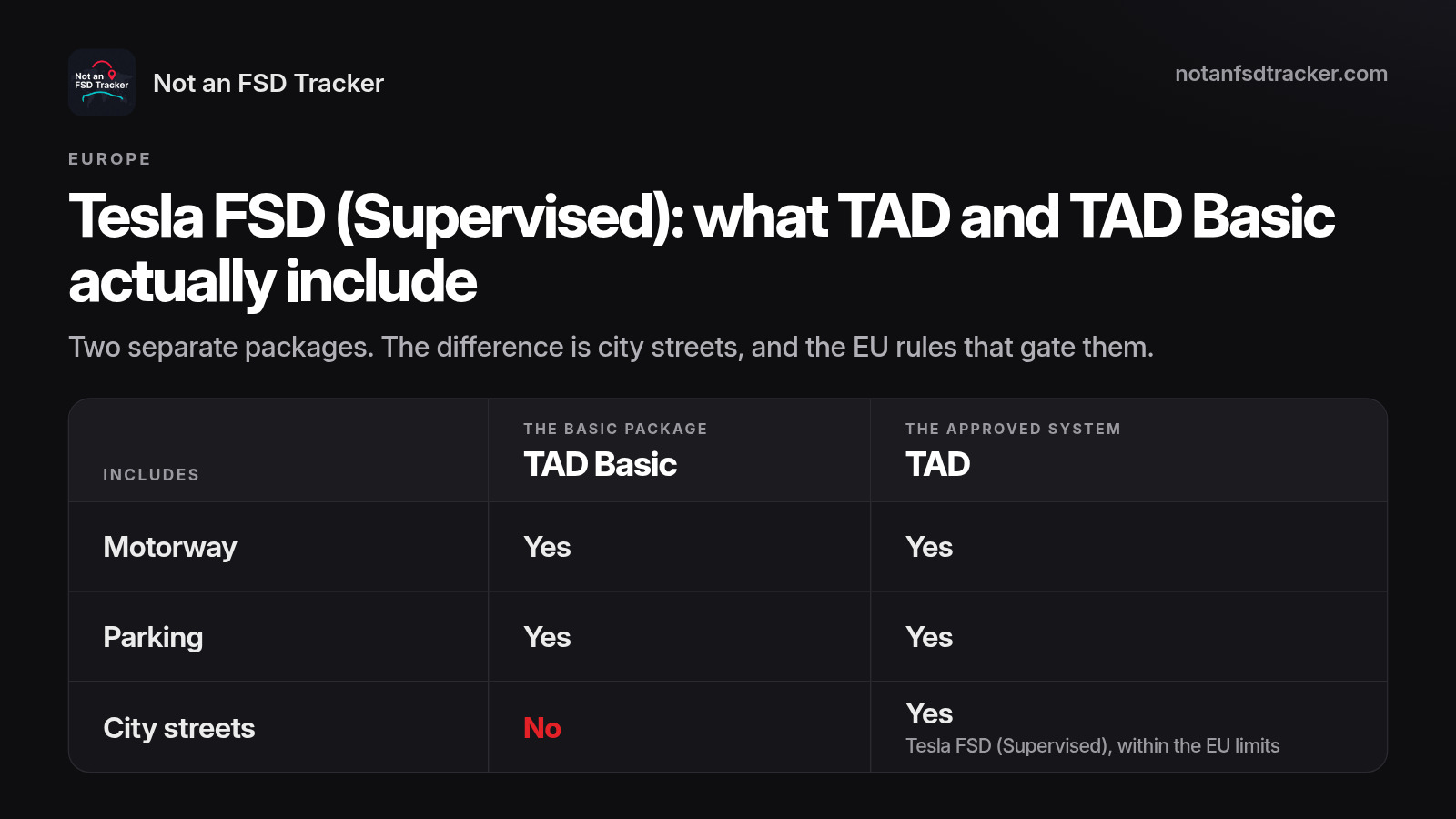
Tesla has started selling a monthly subscription in Europe called Tesla Assisted Driving Basic. The name is easy to confuse with Tesla Assisted Driving, but they are different packages. Tesla Assisted Driving (TAD) is the European name for Tesla FSD (Supervised). TAD Basic is a separate package. "Basic" means you don't get supervised driving on city streets, which most European countries haven't approved yet.
TAD is Tesla FSD (Supervised) with a new name
Tesla now uses the name Tesla Assisted Driving for Tesla FSD (Supervised) in Europe and the UK. The new name was on Tesla's European websites by 8 October 2026, after Germany's Federal Ministry of Transport said the "FSD" label was somewhat misleading. I covered that change in Why Tesla is renaming FSD in Europe to Tesla Assisted Driving, and the German position in Germany's transport ministry statement on Tesla Assisted Driving.
The system still assists with accelerating, braking and steering. It doesn't make the car self-driving, and the driver stays fully responsible.
The RDW, the Dutch authority that first approved the system on 10 April 2026, approved the new name for the car's display and manual on 3 November. It said the rename doesn't change how the system works. It remains a driver-assistance system, and the driver remains responsible for driving.
What TAD Basic includes, and what it leaves out
Tesla's subscription page says Tesla Assisted Driving (TAD) Basic will assist with lane changes, navigating more complex environments and parking spaces, and manoeuvring around objects to come and find you in a car park within your direct vicinity. Everything after lane changes is Tesla's description of Smart Summon. You can subscribe from the Tesla app, or add it when you order a new car. What you get depends on your car's hardware, software, and the rules in your country.
Tesla also says TAD Basic and Tesla Assisted Driving are separate packages. In countries that haven't approved the full system, Basic is the package on offer. What it leaves out is supervised driving on city streets, including turns and junctions. That is the part that still needs approval country by country.
If you already have TAD Basic and your car has the required hardware, Tesla says the software switches to Tesla Assisted Driving at no extra cost once your country approves it and the car gets the update. The same page says you can't use Tesla Assisted Driving by driving into an approved country if your car is registered in one that hasn't approved it. If your car doesn't have the required hardware, you can only subscribe to TAD Basic.
TAD without "Basic" is FSD inside today's EU limits
Tesla Assisted Driving, without the word Basic, is Tesla FSD (Supervised) running inside the current European limits. Twelve EU countries allow it. The RDW granted the type approval in the Netherlands, and eleven countries have recognised it: Lithuania, Estonia, Denmark, Belgium, Slovenia, the Czech Republic, Croatia, Slovakia, Latvia, Finland and Italy. The live list is on the EU tracker. The approved European build is for Hardware 4 and later. The RDW has said the European software isn't the same as the US version of FSD (Supervised).
| TAD Basic | TAD | |
|---|---|---|
| What it is | A separate package, offered where the full system isn't approved or the car lacks the hardware | Tesla FSD (Supervised) under its European name, inside current EU limits |
| Motorway and parking | Yes: lane changes, parking, and Smart Summon to come and find you in a nearby car park | Yes |
| City streets | No | Yes, in the Netherlands and the countries that have recognised its approval |
| Hardware | Hardware 3 or later | Hardware 4 or later |
| If your country later approves TAD | Tesla says a Basic subscription switches to TAD at no extra cost, once the car is eligible and has the update | Already the full package, still inside the EU limits below |
The limits that still apply in the EU
The driver stays 100% responsible, with eyes on the road and ready to take over at any moment. On the approved system, your hands don't have to rest on the wheel, but they must be able to take over immediately. Sensors watch whether your eyes are on the road and whether your hands are available. If you aren't paying attention, the system warns you, and if that keeps happening it can stop you enabling it for a time. A 16 November update approved by the RDW adds earlier warnings, a full strike if you're inattentive while the system is carrying out a manoeuvre, and a requirement to keep your hands on the wheel above 130 km/h.
The driver can set a margin above the detected speed limit, but that margin has been cut from +50% to a maximum of +10%, and it resets to 0% every time you start the car. Germany's transport ministry said on 6 October that it had agreed the +10% cap with Tesla, and the RDW approved it on 3 November.
The split between motorway and city driving comes from the rules. Older steering rules under UN Regulation No. 79 cover basic Autopilot-style lane keeping. The rulebook for Tesla FSD (Supervised) is UN Regulation No. 171, for Driver Control Assistance Systems, or DCAS. I explain that framework in Tesla FSD regulations for the EU and UK: UNECE, DCAS and UN R171.
The current Dutch approval uses R171 Series 01, plus an exemption under Article 39 of Regulation (EU) 2018/858, because the Series 01 text did not fully cover system-initiated manoeuvres in towns. That exemption is why city-street driving, and system-initiated lane changes off the motorway, are only available where a country has accepted the Dutch approval.
What happens next
On 15 December 2026 the EU's Technical Committee on Motor Vehicles meets in Brussels, with Tesla Assisted Driving on the agenda "with possible vote" for EU-wide type approval. That meeting, and the vote maths, are in Tesla FSD (Supervised) TAD faces a possible EU vote on 15 December.
UN R171 Series 02 is due to enter into force on 27 December 2026. That date is the Department for Transport's reading of the official notice, covered in the DfT FOI on UN R171 Series 02. Series 02 adds system-initiated manoeuvres on urban roads, with hands on the wheel, to the standard rules, so a system that meets it wouldn't need the current exemption for those. I set out what Series 02 changes in UNECE R171 Series 02: does it kill Tesla FSD in Europe?.
| Date | What happened |
|---|---|
| 10 April 2026 | RDW grants provisional type approval for FSD Supervised in the Netherlands |
| 6 October 2026 | Germany's BMV sets out the rename, the +10% speed cap, and 100% driver responsibility |
| 8 October 2026 | Tesla's European websites are using the Tesla Assisted Driving name |
| 3 November 2026 | RDW approves the TAD name and the +10% speed margin, resetting to 0% at start, for Hardware 4 and later |
| 16 November 2026 | RDW approves earlier inattention warnings, a full strike during manoeuvres, and hands on the wheel above 130 km/h |
| 15 December 2026 | TCMV meets, with Tesla Assisted Driving on the agenda "with possible vote" |
| 27 December 2026 | UN R171 Series 02 enters into force, on the Department for Transport's understanding |
It looks like Tesla has split the European product so that the name matches what each country allows, but that's an inference. The EU is still deciding how widely the full system can run.
FAQ
What is the difference between TAD and TAD Basic?
Is TAD the same as Tesla FSD (Supervised)?
Which countries have Tesla Assisted Driving without Basic?
If I subscribe to TAD Basic, do I get the full system when my country approves it?
Can I use TAD by driving into an approved country?
What limits still apply to TAD in the EU?
Sources
- Tesla Support UK: Tesla Assisted Driving Basic Subscriptions (captured 15 October 2026)
- Tesla Support UK: Autopilot and Tesla Assisted Driving Basic
- RDW: explanation of the European type approval, 10 April 2026
- RDW: approves changes to Tesla's driver assistance system, 3 November 2026
- RDW: Tesla driver assistance system receives update, 16 November 2026
- BMV: Aktueller Stand bei der Genehmigung eines Tesla-Assistenzsystems, 6 October 2026
- Draft agenda of the 120th TCMV meeting, 15 December 2026, item 4