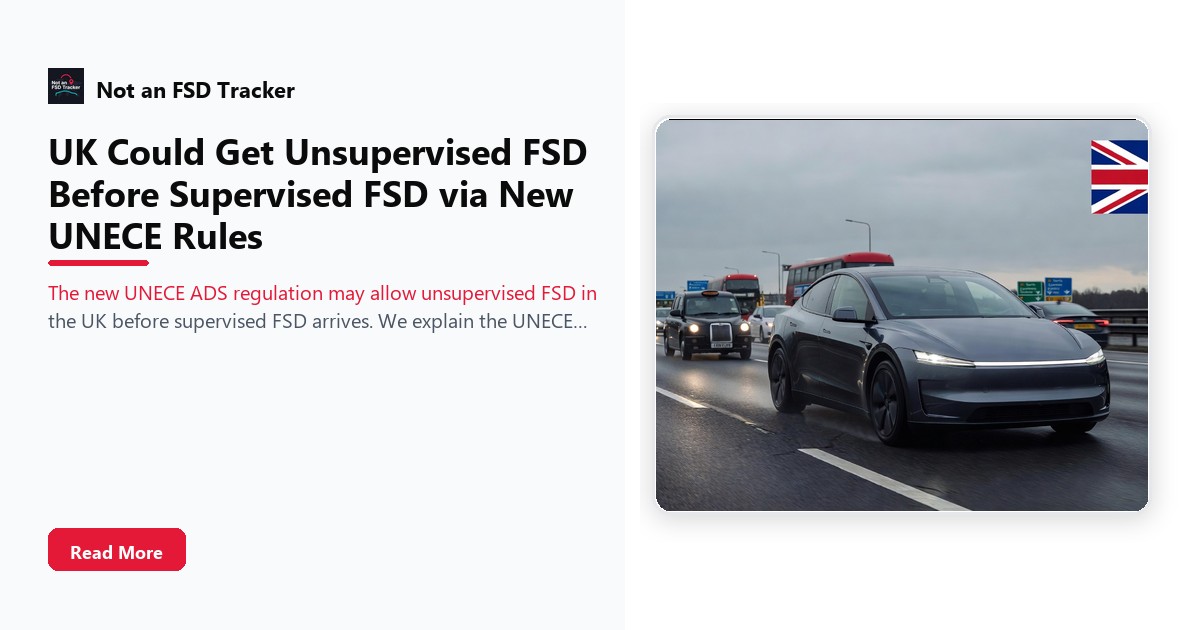
UK Could Get Unsupervised FSD Before Supervised FSD via New UNECE Rules
It sounds counter-intuitive, but the United Kingdom may actually receive fully unsupervised FSD before the supervised version becomes widely available. The reason lies in the different regulatory pathways created by recent UNECE decisions and how the UK has chosen to implement them.
What Is UNECE and Why It Matters for Global AV Rules
The United Nations Economic Commission for Europe (UNECE) develops international vehicle regulations through its World Forum for Harmonization of Vehicle Regulations (WP.29). These rules are adopted by dozens of countries worldwide and form the backbone of type approval systems far beyond Europe. Even after Brexit, the UK remains a contracting party to the 1958 Agreement and incorporates UNECE regulations into its Great Britain type approval system via the Vehicle Certification Agency (VCA).
This continued participation gives the UK direct access to the latest global standards without needing to wait for EU transposition. It also positions the VCA as an independent approval body that can move at its own pace on emerging technologies such as automated driving systems.
Why Unsupervised ADS Rules Advanced Faster Than Supervised DCAS Updates
In June 2026, UNECE adopted the first dedicated global regulation for Automated Driving Systems (ADS). This framework specifically targets Level 4 and Level 5 vehicles that can operate without any human driver. At the same time, updates to Driver Control Assistance Systems (DCAS) rules, which cover supervised systems like current FSD Supervised, were also advanced but followed a different and slower track.
The ADS regulation provides a complete safety case structure for vehicles with no driver required. Supervised FSD, still classified as a Level 2 system, has had to wait for incremental improvements to older DCAS regulations. This regulatory sequencing is why unsupervised commercial operations now have a clearer international pathway than advanced supervised features in some markets.
The distinction is not merely bureaucratic. ADS rules were designed from the ground up for vehicles that must handle every aspect of the driving task within their operational design domain. DCAS updates, by contrast, must preserve the fundamental assumption that a human driver remains responsible and attentive at all times. Reconciling these two philosophies within a single regulatory document proved more complex than creating a standalone ADS framework.
Markets Affected by the New UNECE ADS Regulation
| Region / Country | Status | Relevance to Tesla |
|---|---|---|
| European Union (27 countries) | Contracting party | Direct adoption possible via EU type approval |
| United Kingdom | Contracting party | VCA can use ADS rules for Robotaxi approval |
| Japan, South Korea | Contracting parties | Major Asian markets with active AV programmes |
| Australia, Canada | Contracting parties | Potential future expansion markets |
| United States | Not a contracting party | Tesla using state-level approvals instead |
UK Regulatory Landscape and the Automated Vehicles Act 2024
It is important to note that the UK Automated Vehicles Act 2024 was primarily designed to enable commercial self-driving services rather than personal supervised systems. This aligns with the UNECE ADS regulation and explains why unsupervised commercial fleets may reach the UK ahead of widespread supervised FSD for private owners.
The Act creates a licensing regime for authorised self-driving entities and places clear responsibilities on operators when vehicles are operating in automated mode. It does not necessarily create a fast-track route for supervised Level 2 systems, which continue to fall under existing road traffic law and VCA type approval processes. This deliberate focus on commercial unsupervised operations is one reason analysts believe the first true driverless services in Great Britain could be Robotaxi-style deployments rather than personal vehicle features.
Key Regulatory Distinctions Between ADS and DCAS Pathways
Understanding why the UK timeline for unsupervised operations may diverge from supervised FSD requires looking at the structural differences between the two regulatory tracks.
- Operational Design Domain (ODD) Requirements: ADS rules demand explicit definition and validation of the exact conditions under which the system can operate safely without human intervention. DCAS rules assume the driver can always take over, reducing the need for exhaustive ODD mapping.
- Minimum Risk Manoeuvre (MRM) Standards: The new ADS framework includes detailed requirements for how a vehicle must reach a safe state if it encounters conditions outside its ODD. Current DCAS guidance leaves more of this responsibility with the human driver.
- Data Recording and Accountability: ADS regulations mandate comprehensive event data recording that attributes responsibility to the automated driving system or its operator. Supervised systems still place primary legal responsibility on the human driver.
- Approval Evidence Burden: Manufacturers seeking ADS approval must submit far more extensive simulation, track testing, and real-world validation packages than those required for incremental DCAS updates.
Timelines for Unsupervised FSD in the UK
The new UNECE ADS framework creates a structured route for the UK. Tesla will still need to submit detailed safety evidence to the VCA, including real-world data, simulation results, and minimal risk manoeuvre strategies. Realistic expectations point to initial limited unsupervised operations possibly in 2027, with broader commercial rollout in 2027-2028.
This timeline is separate from supervised FSD, which may still require additional DCAS updates or national exemptions before full rollout. It seems likely that the first unsupervised deployments in the UK will be commercial fleets operating in tightly defined urban or highway corridors rather than consumer-owned vehicles using supervised FSD features.
Tesla Unsupervised Commercial Rollout in the United States
While regulatory discussions continue in Europe and the UK, Tesla has already begun unsupervised commercial Robotaxi operations in the United States. The service launched in Austin, Texas in early 2026 with no safety monitor required. Operations have since expanded to Dallas and Houston, with further cities including Phoenix and Miami planned.
These deployments use the latest AI4 hardware and represent true Level 4 operation in specific operational design domains. No equivalent unsupervised personal use is currently offered to individual owners anywhere in the world. The US experience provides Tesla with valuable real-world data that could accelerate VCA submissions in the UK once the regulatory pathway is fully open.
Implications for Tesla Owners and Future Product Strategy
For existing Tesla owners in the United Kingdom, the regulatory split between ADS and DCAS pathways has practical consequences. Supervised FSD features may continue to roll out gradually through software updates as DCAS rules evolve. At the same time, the first vehicles capable of true unsupervised operation are more likely to appear first in commercial fleets.
This sequencing could influence Tesla's UK product strategy. The company may prioritise securing ADS certification for a dedicated Robotaxi variant before pushing the most advanced supervised features to the existing consumer fleet. Owners should therefore monitor both the VCA and UNECE announcements closely, as the order of feature arrival may not follow the pattern seen in other markets.
Outlook and What to Watch Next
The coming 12 to 18 months will be critical. The VCA is expected to publish detailed guidance on how it intends to apply the new UNECE ADS regulation, including submission formats and validation requirements. Tesla's progress in US cities will also provide a real-world benchmark that UK regulators can reference.
Stakeholders should watch for the first formal ADS type approval applications in any contracting party, the publication of VCA technical guidance, and any statements from the UK Department for Transport clarifying how the Automated Vehicles Act 2024 will interact with the new international rules. These signals will give the clearest indication of when unsupervised operations could realistically begin in Great Britain.