
Netherlands FSD Data Reveals 3.5x Fewer Collisions Than Human Drivers: Europe’s Regulators Can No Longer Ignore the Evidence
Recent data from the Netherlands shows that Tesla vehicles running FSD Supervised are involved in 3.5 times fewer collisions than human-driven cars. This real-world safety evidence, as provided by @teslaeurope (link), should be impossible for other European regulators to ignore.
The Netherlands Data: Hard Evidence of Safety Benefits
The Netherlands became the first EU country to grant national type approval for Tesla FSD Supervised in April 2026. Since then, the system has been operating on public roads under the RDW’s oversight. The latest figures indicate a dramatic reduction in collision rates compared to human drivers.
This is not theoretical modelling or closed-track testing. It is data from actual supervised FSD use in one of Europe’s most complex road environments, complete with cyclists, roundabouts, and variable weather. A 3.5× reduction in collisions represents one of the clearest safety signals yet for advanced driver assistance systems in Europe.
Why This Matters for the Rest of Europe
Supervised FSD is not full self-driving. The driver remains responsible. Yet the Netherlands results suggest that even in its current supervised form, the technology is already delivering measurable safety improvements. If other European countries adopted similar approvals, thousands of collisions could potentially be avoided each year.
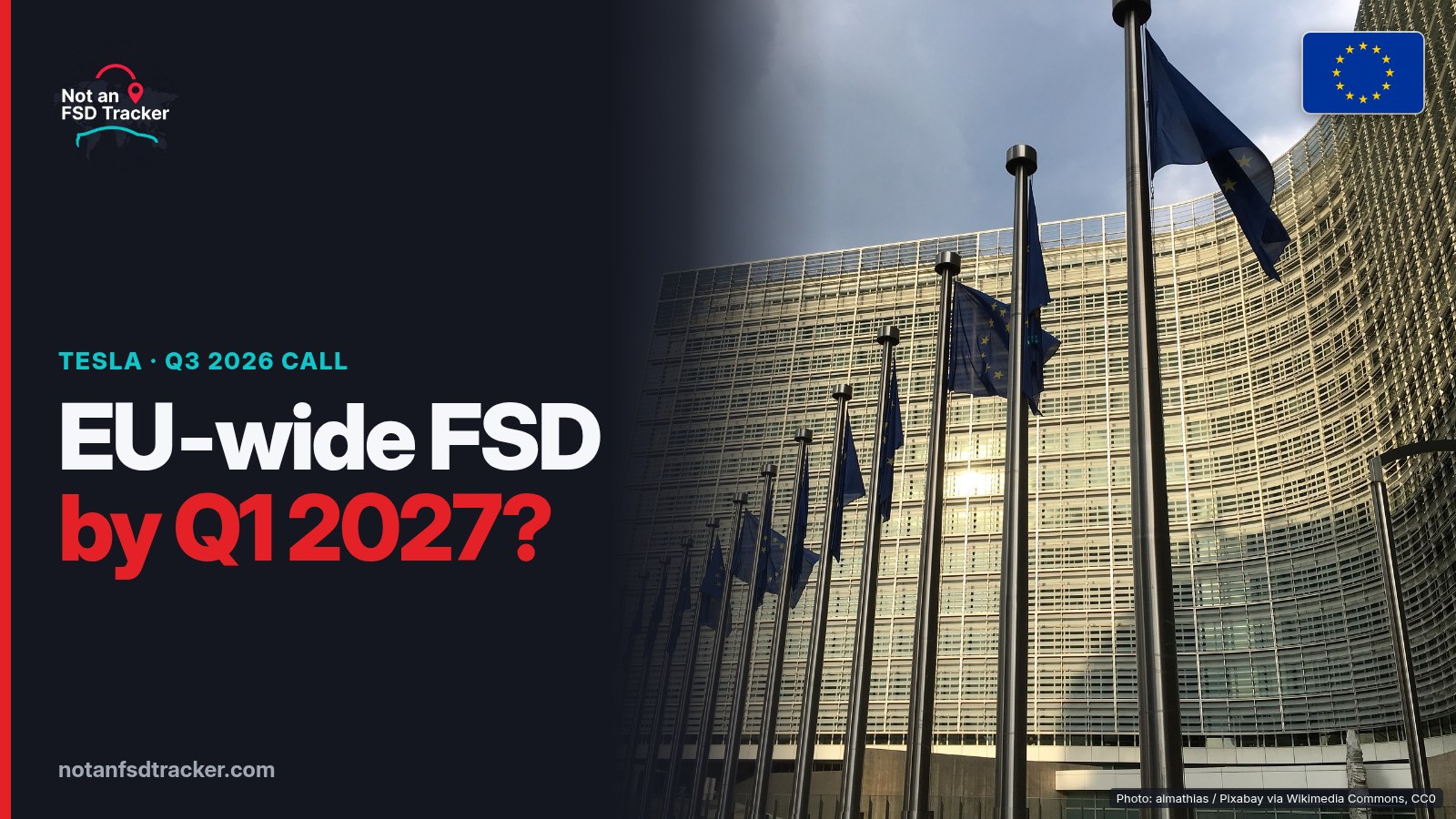
Instead, progress across much of the EU remains painfully slow. Many national regulators continue to default to “we are waiting for the EU process” or demand additional local testing that largely duplicates the extensive work already done by the Dutch RDW. This approach delays access to technology that is already proving its value on real roads.
European Regulators Still Stalling - Summary
Here are some of the key European regulators whose current positions effectively stall or significantly delay FSD Supervised rollout, despite the growing body of safety data from the Netherlands:
| Country | Regulator / Stance | Why They Are Stalling |
|---|---|---|
| France | Awaiting EU Vote | Explicitly waiting for the outcome of the EU technical committee review before taking national action. |
| Germany | Awaiting EU + Active Pilot | Running a limited local shuttle pilot in the Eifel region but still awaiting the full EU dossier for broader approval. |
| Italy | Cautious - Likely Wait for EU | Taking a cautious approach and monitoring the EU process rather than moving independently. |
| Poland | Requires Local Testing | Refuses to automatically accept the Dutch approval; insists on additional local testing and evaluation. |
| Czech Republic | Reviewing RDW Decision | Stating that the Dutch approval is not automatically binding and that further assessment against Czech rules is required. |
| Denmark | No Comment (Confidentiality) | Refuses to comment on individual type approval cases due to legal confidentiality obligations. |
| Finland | Decision in 2026 via EU | Stating that a regulatory decision is expected during 2026 but only through the EU process. |
| Latvia | Testing - Issues Found | Testing revealed issues with traffic light recognition and adaptation to local conditions; further improvements required before progress. |
| United Kingdom | DVSA / Department for Transport | Has its own post-Brexit regulatory framework under the Automated Vehicles Act. Progressing independently of the EU process. |
The list above is not exhaustive. A large number of other member states have simply issued no public statement at all, effectively defaulting to a “wait and see” position while the Netherlands continues to gather real-world safety data.
Current Status and Outlook
The Netherlands has moved from approval to real-world safety results. Other European countries now have concrete data showing meaningful collision reductions. Continuing to stall behind “awaiting the EU process” or demanding redundant local testing is becoming increasingly difficult to justify on safety grounds. Subscribe to the mailing list for updates.