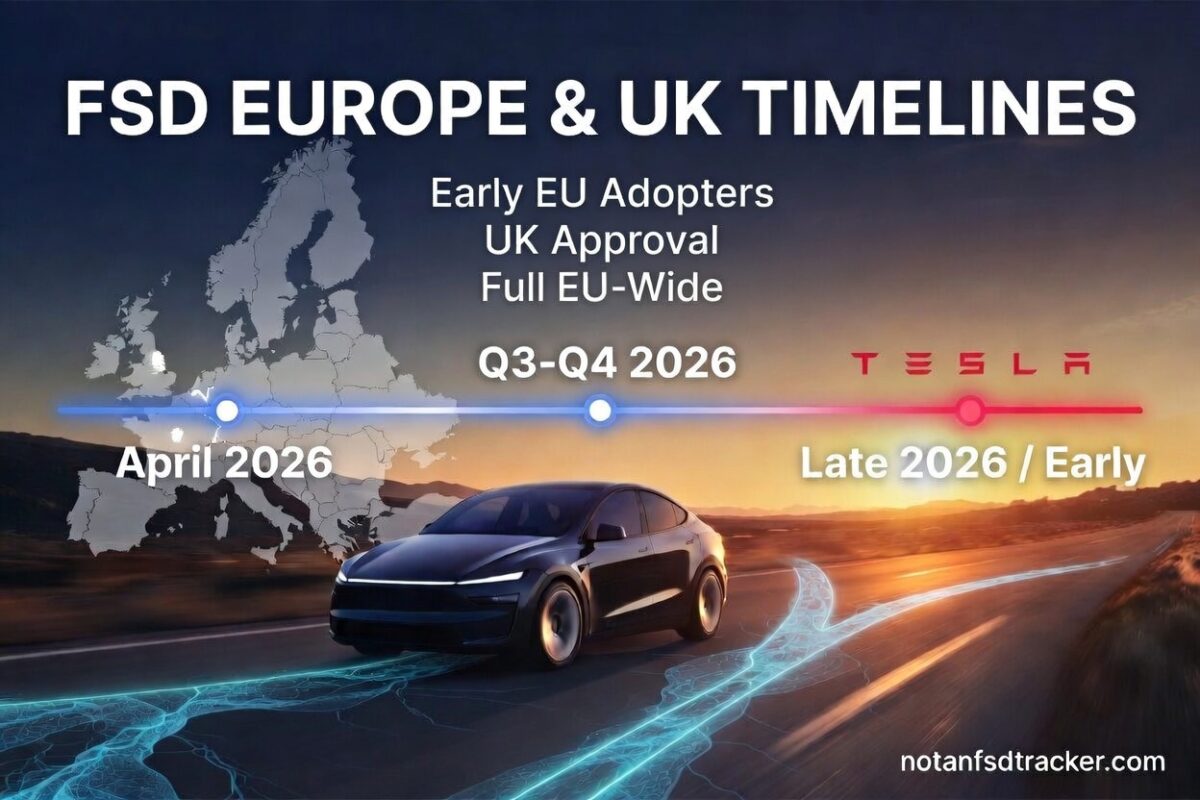
Tesla has secured approval for its Full Self-Driving (FSD) Supervised system from the RDW in the Netherlands. This April 2026 decision marks the first time an EU member state has authorized advanced software for public roads under supervised conditions. The breakthrough has generated significant interest in fsd europe approval and exact fsd europe dates across the continent.
This development positions the Netherlands as a pioneer in self-driving Europe. Tesla’s FSD Supervised uses advanced neural networks, cameras, and real-time data to manage complex driving tasks while still requiring driver attention. The approval followed extensive local testing and compliance with key safety standards. For more on Dutch vehicle regulations, see the official RDW website.
Understanding the Dutch Approval and Its EU Impact
The RDW approval allows Dutch Tesla owners to activate FSD Supervised features such as advanced navigation, automatic lane changes, traffic light recognition, and stop sign control. While supervised, it represents meaningful progress toward greater autonomy. This sets a precedent for mutual recognition across the EU single market, influencing both the FSD timeline in Europe and broader self-driving Europe adoption.
Europe has historically approached autonomous systems cautiously due to concerns about liability, safety, and harmonization. The Netherlands’ forward-leaning approach makes its decision particularly influential. Two distinct regulatory paths now exist for expanding FSD Europe approval: individual country adoption of the RDW decision or full EU homologation via the Technical Committee on Motor Vehicles (TCMV).
The Two Paths for EU FSD Rollout
Path 1: Individual Country Adoption of RDW Decision
Under EU type approval rules, other member states can recognize Dutch testing data and approvals. This mutual recognition enables faster, country-specific rollouts. Progressive nations such as Germany, Sweden, Belgium, and France are likely early adopters given their established autonomous vehicle programs and strong Tesla presence. Estimates based on similar ADAS expansions suggest 3 to 9 months for these markets.
This path offers speed but may result in a patchwork rollout with varying restrictions by country. Local factors, including infrastructure readiness, data privacy under GDPR, and public acceptance, will influence timelines.
Path 2: EU-Wide Homologation via TCMV
For uniform deployment across all 27 EU nations, they can pursue (and have already started) centralized homologation through the TCMV. This committee advises the European Commission on vehicle regulations and ensures consistency. The process involves additional safety validations, stakeholder input, and alignment with UNECE standards such as Regulation 157 for automated lane keeping.
While slower, this route provides legal certainty and enables seamless cross-border use. Historical examples suggest ~ 1 year for approval but can be lower since the TCMV meet regularly. For details on UNECE vehicle regulations, visit the official UNECE site. Full FSD Europe date under this path would likely target 2027 or early 2028.
UK FSD Prospects and Timelines
Post-Brexit, the United Kingdom operates independently through its Vehicle Certification Agency. Tesla has conducted public demonstrations of FSD in complex locations, including London and Swindon roundabouts. These videos strongly suggest Tesla has already applied for type approval and can leverage RDW testing data to accelerate the process.
UK FSD date estimates range from 4 to 10 months following the Dutch approval, potentially enabling supervised use by late 2026 or early 2027. This independent path could allow the UK to move faster than some EU nations.
Estimated Timelines and Historical Precedents
Timelines remain estimates based on regulatory history, political will, and technical validation needs. The tables below provide structured comparisons.
| Pathway | Earliest Adopters | Estimated Timeline from April 2026 | Full Coverage Target |
|---|---|---|---|
| Individual RDW Adoption | Netherlands, Germany, Sweden, France, Belgium | 3-9 months (Q3-Q4 2026) | Various EU countries by the end of 2027 |
| EU TCMV Homologation | All 27 EU Member States | 12-24 months | 2027-2028 |
| UK Independent Approval | United Kingdom | 4-10 months (mid-2026 to Q1 2027) | UK-wide by 2027 |
These projections assume successful data sharing and no major safety incidents. Individual adoption offers quicker access in key markets while TCMV ensures uniformity.
| System/Company | Jurisdiction | Application to Approval | Key Notes |
|---|---|---|---|
| Mercedes Drive Pilot (Level 3) | Germany/EU | ~18-24 months (2020-2022) | First EU Level 3 system; expanded to additional countries within 12 months via mutual recognition |
| UNECE R157 (ALKS) | EU-wide | 18 months (2019-2021) | Foundation for many current FSD-like features |
| Mobileye SuperVision ADAS | Multiple EU nations | 6-15 months per market | Demonstrates that software updates accelerate after initial hardware approval |
| Tesla Enhanced Autopilot expansions | EU countries | Phased over 12-36 months (2019-2023) | Demonstrates software updates accelerate after initial hardware approval |
The tables show that pioneering approvals in countries such as the Netherlands often accelerate broader adoption. Mercedes’ Level 3 experience particularly supports the potential for rapid individual country uptake following the Dutch RDW decision.
Challenges and Broader Implications for Self Driving Europe
Despite progress, several challenges remain. Regulators must clarify liability when FSD Supervised is active. The EU AI Act and updated product liability rules will shape future frameworks. Public trust depends on transparent communication about system capabilities and limitations.
Additional considerations include infrastructure readiness across diverse European road networks, data localization requirements, and competition from traditional manufacturers advancing their own systems. Successful rollout could reduce accidents, boost productivity, and strengthen Europe’s position in sustainable mobility.
FAQ
When will FSD become available in other EU countries after the Netherlands approval?
Individual countries may adopt the RDW decision within 3-9 months for early adopters such as Germany and France. Full EU-wide approval via TCMV is estimated at 12-24 months, targeting 2027-2028.
What are the two main paths for fsd europe approval?
The two paths are for individual EU member states to adopt the Dutch RDW approval through mutual recognition, or to pursue centralized EU homologation through the TCMV for uniform standards across the EU.
When is the expected FSD UK date?
Given existing demonstration videos in London and Swindon and the ability to use RDW data, UK approval could occur within 4-10 months, potentially by late 2026 or early 2027.
How does the Netherlands approval affect the overall FSD timeline in Europe?
It creates a regulatory precedent that can accelerate individual country adoptions and inform the longer EU-wide TCMV process, potentially shortening the overall FSD timeline in Europe by establishing proven safety data from Dutch roads.
Get Updates
For the latest updates on autonomous driving in your region: Subscribe here and get email alerts when FSD becomes available in your area.